
Why do I feel down during the holidays?


- Why do the holidays make me sad when they're supposed to be happy?
- What usually sits behind the holiday blues?
- Why does missing someone hurt more at the holidays?
- Why do family gatherings leave you so drained?
- Why can you feel lonely even in a crowded room, or on your own?
- Is it the holidays, or the shorter days?
- What can you do this week to feel a little steadier?
- What if your child or teen seems down over the holidays?
- When is it more than the holiday blues?
- How can counseling help with a hard holiday season?
- Can you start therapy in the middle of the holiday rush?
- If your family is military: holidays apart
- A made-up example: planning for one hard holiday
- Frequently asked questions
- Key takeaways
- More in this section
- Sources
The short version
- Holiday sadness is common and usually has a cause: money, family, grief, loneliness or sky-high expectations.
- Shorter days, late nights, rich food and extra drinks can drag your mood down further.
- Small moves help: protect sleep, get daylight, say no to some plans and plan ahead for the hard days.
- If the low mood lasts two weeks or more, sticks around after New Year's or comes back every year, talk with a counselor.
For anyone in Texas who feels low, tired or teary while everyone else seems merry, and wants to know why and what helps.
Why do the holidays make me sad when they're supposed to be happy?
Feeling down during the holidays is common, and there’s usually a reason: the season piles extra pressure on your money, time, family relationships and expectations, and it often brings up whoever or whatever is missing. Shorter days, broken routines, less sleep and more alcohol can pull your mood lower still. Holiday blues usually ease once the season passes, but if a low mood lasts for weeks, shows up most days or gets in the way of daily life, it’s a good time to talk with a counselor.
If this season feels heavier than it should, you don’t have to wait it out alone. Our depression counseling therapists work with you in person at our Texas locations or online to understand what’s weighing on you and build a plan that fits your life. The rest of our Depression guides answer the next questions people ask, from what counseling looks like to how to get started.
What usually sits behind the holiday blues?
The holidays ask a lot of you, all at once. More to buy, more to cook, more places to be, usually on less sleep and with your routine out the window. Add the pressure to feel joyful on cue, and it makes sense that your mood dips.
You’re far from alone. In a 2023 American Psychological Association poll of 2,061 U.S. adults, 89% said something about the season causes them stress. Money topped the list at 58%, and 38% named missing family or loved ones.
- Expectations. Movies and social feeds sell a perfect season. Real life has burned rolls and a relative who brings up politics.
- Money. Gifts, travel and hosting stretch budgets that already felt tight.
- Missing people. A loss, a breakup or distance from family shows up loudest at the table.
- Broken routines. Late nights, rich food and extra drinks wear down how you feel.
None of this means something is wrong with you. You’re carrying a heavy season, and it’s okay to feel the weight of it.
Why does missing someone hurt more at the holidays?
Holidays run on traditions, and traditions have people in them. The first Thanksgiving without your mom’s stuffing or the stocking nobody hangs anymore can bring grief right back to the surface, even years after a loss. A divorce, an estrangement or a deployment can leave an empty chair too.
In a November 2025 American Psychiatric Association poll of 2,203 U.S. adults, 48% said they were worried about missing someone or grief over the holidays, and 31% were worried about being lonely.
- Make room for them. Share a story, cook their recipe or light a candle.
- Keep what comforts you. Set aside the traditions that only hurt right now.
- Warn one person. Tell someone ahead of time that a certain day will be hard.
- Give yourself an exit. It’s okay to step outside or leave early.
Our blog has more on The Holidays After the Death of a Loved One, and grief and loss counseling gives you a place to carry it with support.
Why do family gatherings leave you so drained?
You can love your family and still dread a long weekend under one roof. Old roles come back fast: the peacemaker, the one who always hosts, the one everyone worries about. Add tight quarters and a few hot-button topics, and it’s easy to drive home exhausted and low.
Plan before you arrive:
- Set your stay. Decide how long you’ll be there. Your own car or a hotel room can be a gift to yourself.
- Pick your no-go topics. Have a line ready: “I’m going to pass on that one today. How’s the new job?”
- Build in breaks. A walk around the block or a run to the store.
- Lower the bar. The goal is a decent day, not a perfect one.
Our blog post on Coping with Family Tension During the Holidays goes further. If it’s your first season juggling stepkids, exes and two sets of traditions, read our guide to Blended Families and When Counseling Helps. And if the same blowup happens every year, family counseling can help everyone talk without the old script taking over.
Why can you feel lonely even in a crowded room, or on your own?
Loneliness at the holidays isn’t only about being by yourself. You can sit at a packed table and still feel unseen, especially if you’re keeping something to yourself or nobody seems to notice you’re struggling. It can also come from feeling outside the season: single when everyone seems coupled up, newly sober at parties built around drinks, far from home, or celebrating different holidays (or none) while the whole city is decorated for one.
If you’ll be alone for the day, by choice or not, a little planning keeps it from feeling endless:
- Sketch the day. Unstructured hours are where low moods grow. Plan a morning, an afternoon and an evening.
- Mix comfort with connection. A favorite movie and a good meal, plus one video call or a walk where you’ll see neighbors.
- Go first. Text one person instead of waiting to be invited, or sign up for a volunteer shift.
- Go easy on the scrolling. A feed full of family photos can make a quiet day feel lonelier than it is.
Get matched with a therapist
Easily schedule your appointment online at one of our locations in Central Texas.
Is it the holidays, or the shorter days?
Sometimes it’s both. The National Institute of Mental Health separates the “holiday blues,” sadness or anxiety brought on by the stresses of a certain time of year, from seasonal affective disorder (SAD), a type of depression tied to changes in daylight rather than the calendar. With the winter pattern, symptoms usually start in late fall or early winter, ease in spring and often return the next year. Oversleeping, craving carbs and wanting to hibernate are common signs.
SAD is less common in Texas than in places like Alaska or New England, since our winter days are longer. Less common isn’t never, though.
A rough way to tell them apart: holiday blues tend to rise and fall with the events and ease once the guests go home. A seasonal slump settles in as the days get shorter and hangs on well past New Year’s. If you notice the same dip every fall, bring it up with a counselor or your doctor. Either way, daylight is your friend: a morning walk, coffee by a sunny window, lunch outside on a mild winter day.
What can you do this week to feel a little steadier?
You don’t need a full overhaul. A few small habits do a lot of quiet work in a busy season:
- Guard your sleep. Keep a similar bedtime and wake time, even on days off.
- Get outside in daylight. Even a short morning walk helps your body keep its rhythm.
- Move. A walk after dinner or a dance party in the kitchen with the kids all counts.
- Go easy on alcohol. It can feel like it takes the edge off, then leave you lower and more tired the next day.
- Set a spending limit before you shop. Deciding ahead beats lying awake about the credit card bill.
- Say no to one thing. Keep it short and kind: “I can come for dinner, but I’ll head out before dessert.” You can care about their feelings and still protect your own.
- Plan something for January. A lunch with a friend gives you something to look forward to once the decorations come down.
If you already have habits that help, like therapy, exercise or time with your faith community, keep them going. And if the season is landing on top of an exhausting year at work, our guide on How to Recover from Burnout has more ideas.
What if your child or teen seems down over the holidays?
Kids feel the season too. Changed routines, late nights, missing a grandparent, splitting time between two homes or picking up on your stress can show up as meltdowns or a teen who disappears into their room.
- Keep anchors in place. Bedtimes, meals and a little quiet time go a long way during the break.
- Tell them the plan. Knowing who’s coming and when they’ll switch houses lowers worry.
- Make space for mixed feelings. “It’s okay to miss Grandpa and still have fun opening presents.”
- Check in sideways. Teens often open up more in the car than face to face.
If your child’s mood doesn’t bounce back once school starts, or they’ve pulled away from friends or stopped enjoying things they love, it’s worth talking with a counselor. Our therapists see clients from age five through late adulthood, and play therapy is typically for kids 5 to 12.
When is it more than the holiday blues?
Holiday blues usually come and go with the season. It’s worth reaching out to a counselor if:
- the low mood is there most of the day, nearly every day, for two weeks or longer;
- you’ve lost interest in things you usually enjoy, not just the holiday stuff;
- your sleep, appetite or energy has changed a lot;
- it’s hard to keep up with work, school or everyday tasks;
- you feel hopeless, guilty or worthless much of the time;
- you’re isolating or drinking more just to get through;
- it hasn’t lifted by mid-January, or it happens every year.
You don’t need a formal diagnosis to begin therapy. If you’re not sure whether stress has crossed into something bigger, our guide on How to Tell if Stress Is Affecting Your Daily Life walks through the signs.
How can counseling help with a hard holiday season?
Counseling gives you a place to set the holiday load down and look at it with someone who’s on your side. Your first session is mostly about getting to know you and giving you space to talk. From there, you and your therapist build a personalized treatment plan around your goals, at your pace. For a hard season, that might mean:
- planning ahead for a specific gathering, conversation or anniversary;
- working on thoughts that spiral, like “I’ve ruined Christmas,” with cognitive behavioral therapy (CBT), which helps you spot and reshape unhelpful thinking;
- building skills to ride out strong emotions with dialectical behavior therapy (DBT);
- making room to grieve someone you miss;
- sorting out whether a low mood is tied to the season or has been building for a while.
Your counselor can’t fix you, but they can walk with you while you figure out what helps. Our guide on How Counseling Can Help with Depression goes deeper. And if your therapist isn’t the right match after your first sessions, our team will help you move to another provider in our group.
Can you start therapy in the middle of the holiday rush?
Yes, and you don’t have to wait for January. You can register and schedule through our online portal 24/7, and our support staff is available 8am–8pm Monday to Friday and 9am–3pm on Saturdays.
- Online or in person. We have ten locations in Texas. Online sessions take place on a secure, HIPAA-compliant video platform and never cost extra, which helps when your calendar is packed.
- Cost. Our standard private rate is $130 per session, and most sessions last about an hour.
- Insurance. We’re in-network with most major insurance plans, and our team will check your benefits for you. Verification of benefits doesn’t guarantee payment, so ask early. See our Insurance & Payment page.
- Income-based rates. If holiday spending has squeezed your budget, our Affordable Care Program offers sessions as low as $50 with a Counselor Associate or $30 with a practicum student. It doesn’t use insurance.
One practical tip: if your insurance plan year starts over in January, ask your insurer how that affects your deductible before you schedule sessions on either side of New Year’s.
Get matched with a therapist
Easily schedule your appointment online at one of our locations in Central Texas.
If your family is military: holidays apart
For service members and military families, the holidays can mean an empty seat because of a deployment, a first season home that doesn’t feel the way you pictured, or a move far from everyone you know. It’s common to feel proud, lonely and on edge in the same week.
Celebrate on a different day if that’s when you can all be together, set up a video call around a shared meal, and give a returning service member room to ease back in. Our veteran counseling supports veterans, couples and families, and Tricare and TriWest are among the insurance options we list.
A made-up example: planning for one hard holiday
Here’s an illustration, not a real person. Say Maria lost her dad in the spring, and Thanksgiving at her aunt’s house is coming up. She’s dreading the empty chair.
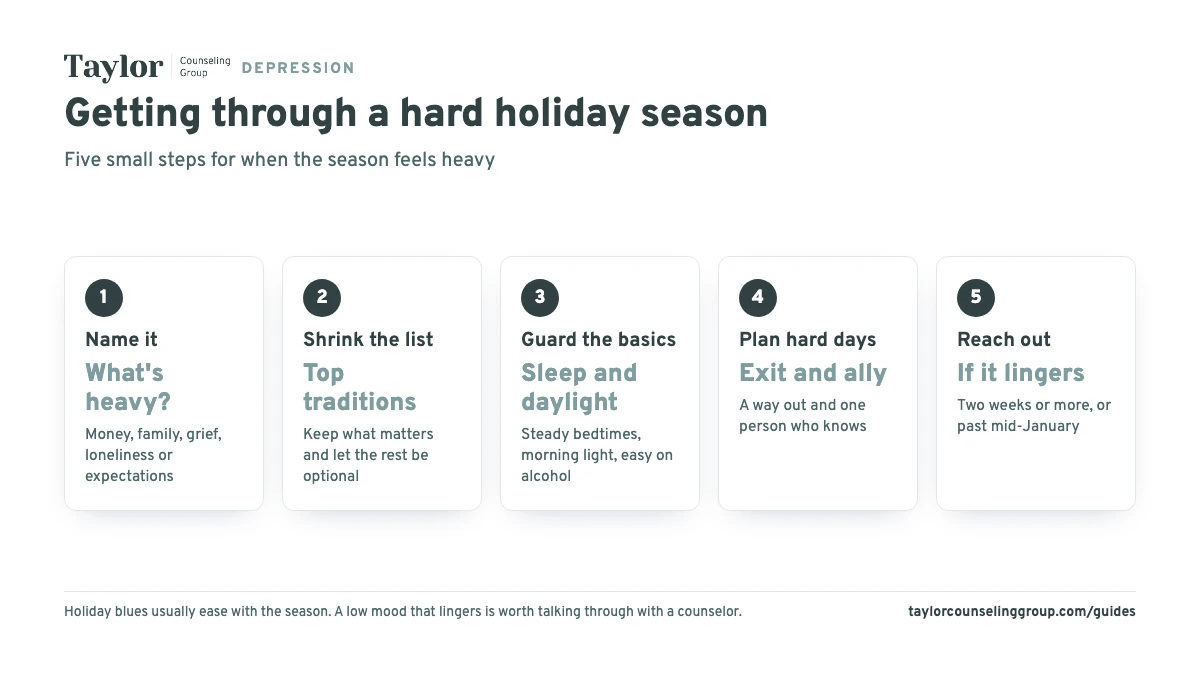
- Name it. She admits it’s grief, not just a busy week, that’s weighing on her.
- Shrink the list. She skips the Friday shopping trip and keeps only the meal.
- Guard the basics. She gets to bed on time and takes a morning walk.
- Plan the hard part. She brings her dad’s pecan pie, tells her cousin she may need a break and drives herself.
- Check in after. If the heaviness is still there in a few weeks, she’ll reach out to a grief counselor.
The day isn’t easy, but it’s hers.
Frequently asked questions
Is it normal to cry at holiday gatherings?
Yes. Holidays stir up memories, family history and a lot of feelings in a short time, and tears are a natural response. Step outside for a minute if you need to.
Why do I feel worse after the holidays are over?
The letdown is real: the lights come down, the bills arrive and the days are still short. Plan a few small things to look forward to in January, and if the low mood hangs on for weeks, talk with a counselor.
Do I need a diagnosis to start counseling for holiday sadness?
No. You don’t need a formal diagnosis to begin therapy. Your first session is about getting to know you and what you’d like help with.
Can my partner and I get help if the holidays always end in a fight?
Yes. If the same arguments about money, in-laws or where to spend the holidays come back every year, couples counseling can help you talk it through and plan ahead together.
Can I do therapy by phone instead of video?
Yes. Phone sessions are available alongside our secure video sessions, and there’s never an extra cost for telehealth.
Key takeaways
- Feeling down during the holidays is common and usually has a cause: money, family, grief, loneliness or expectations.
- Shorter days, broken routines, less sleep and more alcohol can make a low mood lower.
- Small habits help: steady sleep, daylight, movement, a spending limit and permission to say no.
- Plan ahead for the hardest days with a way out and one person who knows.
- If the low mood lasts two weeks or more, lingers past mid-January or returns every year, talk with a counselor; no diagnosis is needed to start.
You deserve affordable, reliable, & accessible care
We accept most major insurances and are dedicated to providing high-quality services at affordable rates. Our support staff is available to answer any questions you may have.
More in this section
Sources
- Even a joyous holiday season can cause stress for most Americans — American Psychological Association
- Americans are More Anxious than Last Year About the Upcoming Holidays; Health Care and the Economy Also Major Concerns for Many — American Psychiatric Association
- Seasonal Affective Disorder — National Institute of Mental Health
- Tips for Managing the Holiday Blues — NAMI: National Alliance on Mental Illness
- Tips for parents on managing holiday stress — American Psychological Association

Dr. Christopher Taylor
Christopher S. Taylor, Ph.D., is the founder of Taylor Counseling Group, an existential psychotherapist and the author of You Are Here. A Board-Approved LPC Supervisor, he was appointed by Governor Greg Abbott to the Texas State Board of Examiners of Professional Counselors, where he was later elected Vice Chair.
This guide is general information from Taylor Counseling Group. It is not medical advice, a diagnosis or a substitute for care from a licensed mental health professional, and reading it does not create a counseling relationship. If you are in danger or need help right away, call 911 or go to the nearest emergency room.