
How do I deal with imposter syndrome?


- How do you deal with imposter syndrome when it hits at work, at school or at home?
- What do you do in the moment the "I'm a fraud" feeling hits?
- How do you stop over-preparing and over-working to prove yourself?
- How do you actually take in praise and wins?
- Who should you talk to about feeling like a fraud?
- How do you handle imposter syndrome at a new job or after a promotion?
- What helps with imposter feelings in college or grad school?
- What if you're the only one like you in the room?
- Can you feel like an imposter as a parent or a partner?
- When is imposter syndrome a sign of anxiety or something more?
- How can counseling help with imposter syndrome?
- How do you start counseling for imposter syndrome, and what does it cost?
- What's different when you look for support in Texas
- A made-up example: working through imposter feelings after a promotion
- Frequently asked questions
- Key takeaways
- More in this section
- Sources
The short version
- Name the feeling when it shows up, and check it against the evidence of what you've actually done.
- Set a "good enough" standard so you stop over-preparing to prove yourself.
- Let praise land, keep a record of your wins and talk to someone you trust outside your peer group.
- If self-doubt is feeding anxiety, low mood or burnout, counseling can help.
For anyone in Texas who keeps waiting to be “found out” at a new job, in a degree program or even as a parent, and wants practical ways to quiet that voice.
How do you deal with imposter syndrome when it hits at work, at school or at home?
To deal with imposter syndrome, start by treating the “I’m a fraud” thought as a feeling, not a fact, and check it against what you’ve actually done. Then break the habits that keep it going: over-preparing, brushing off praise, comparing your behind-the-scenes to everyone else’s highlights and keeping it all to yourself. Imposter feelings often flare again at big transitions, so the goal is a quieter, shorter visit from that voice rather than never hearing it again. If self-doubt is driving anxiety, low mood or exhaustion, a counselor can help you work on the thinking and the patterns underneath it.
Imposter feelings often travel with anxiety, perfectionism and stress, and that’s work our counselors do every day, in person at our Texas locations and online. Learn more about anxiety counseling at Taylor Counseling Group, read our blog post What Is Imposter Syndrome? Signs, Causes & How to Overcome It, or browse more answers in our Anxiety & Stress guides.
What do you do in the moment the "I'm a fraud" feeling hits?
It shows up at the worst time: right before a presentation, the morning of a new job, the second someone says “great work.” A voice says, They’re going to figure out you don’t belong here. Try this quick reset:
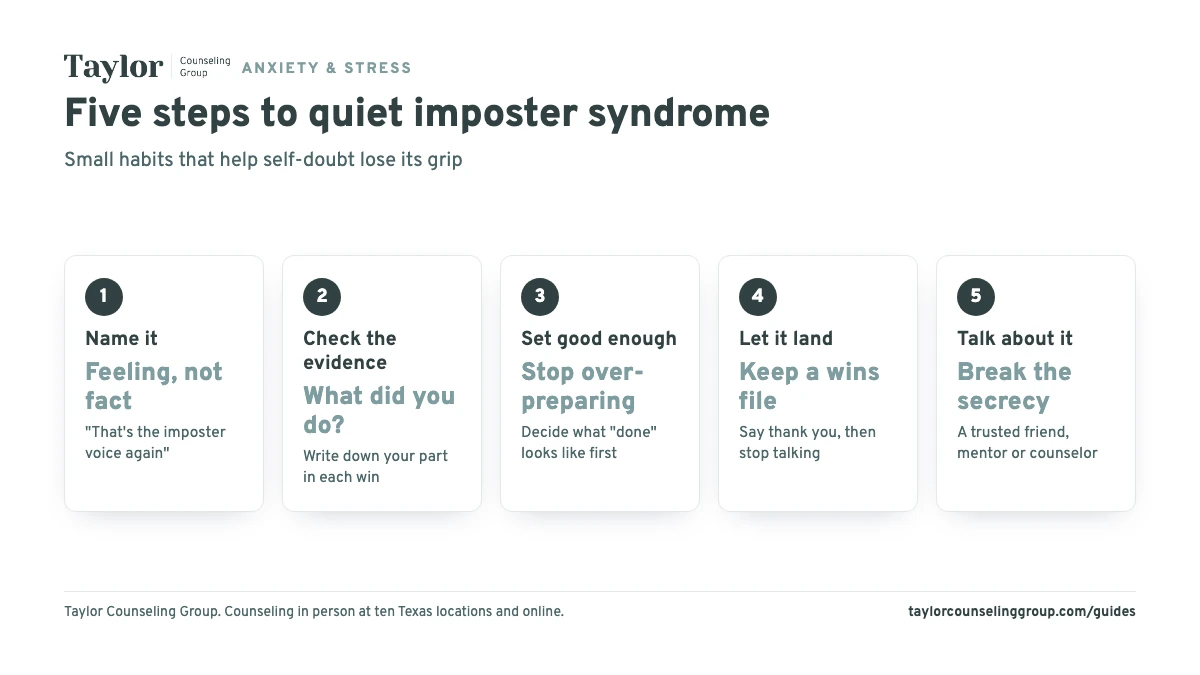
- Name it. “That’s the imposter voice again.” Naming a thought gives you a little distance. It’s a feeling, not a verdict.
- Slow your body down. Take a few slow breaths with a longer exhale and feel your feet on the floor.
- Ask one question. “What do I actually know right now?” I was hired for this. I prepared. I’ve done hard things before.
- Take the next small step. Send the email, walk into the meeting. Action shrinks the feeling faster than waiting to feel ready.
You don’t have to believe you’re amazing. You just have to stop letting the fear make the decision.
How do you stop over-preparing and over-working to prove yourself?
Imposter feelings often run on a loop. A new task shows up, anxiety spikes, and you either put it off or over-prepare like your life depends on it. You get it done, feel a quick wave of relief, then decide you only pulled it off because you worked yourself to the bone (or got lucky). Next time, the pressure is even higher.
Breaking the loop means testing the belief that all that extra effort keeps you safe:
- Decide what “done” looks like before you start, then stop when you hit it.
- Give tasks a time limit. When it’s up, send it or move on.
- Try one small experiment. Prep a little less for one low-stakes meeting and notice what happens. Usually, it goes fine.
- Watch the procrastination side. Putting things off is often fear of not doing it perfectly. A rough first draft takes the pressure off.
You’re not lowering your standards. You’re moving them from “flawless” to “good work I can stand behind.”
How do you actually take in praise and wins?
If you’re dealing with imposter feelings, a compliment can feel like a trap. You deflect it, point out a flaw or quietly decide the person doesn’t know the real you. Over time, that keeps every success from counting.
- Say thank you, then stop talking. No “oh, it was nothing.” Let it sit for a second.
- Keep a wins file. Save kind emails, good reviews and thank-you notes in one folder. Read it on rough days.
- Write down your part. After a success, jot down what you did: the skill, the effort, the choice. Luck may have played a role. So did you.
- Celebrate small things. A test you passed, a hard call you handled. They add up.
For the common signs and where these feelings come from, see our blog post What Is Imposter Syndrome? Signs, Causes & How to Overcome It.
Who should you talk to about feeling like a fraud?
Imposter feelings love secrecy. Part of the experience is believing you’re the only one, and the fear of being “found out” keeps you quiet. Saying it out loud to the right person breaks that spell.
- Someone outside your peer group. A partner, an old friend or a family member can remind you who you are, with no competition attached.
- A mentor a few steps ahead of you. Ask how they felt in their first year. Their story may sound a lot like yours.
- A supportive community of people who share your background or field.
Be careful venting to peers you compare yourself with. It can turn into a contest over who’s more behind. And remember, everyone else’s success has rejections and do-overs behind it that you never see.
How do you handle imposter syndrome at a new job or after a promotion?
New roles are prime time for imposter feelings. Everyone seems to know everything, and you’re expected to perform before you’ve found the coffee filters. That gap between “new” and “expert” is normal. It isn’t evidence that hiring you was a mistake.
- Expect a learning curve. Learning in public is part of the job.
- Ask questions early. They’re much easier to ask in your first weeks than months in.
- Get clear on what success looks like. Ask your manager. A clear target beats a vague fear of falling short.
- Remember why you were chosen. Someone looked at your experience and picked you. Their judgment counts, too.
- Watch for overwork. Proving yourself with late nights and weekend emails can slide into exhaustion. If you’re already running on empty, our guide on How to Recover From Burnout can help.
A promotion can bring the feelings back even after you’d quieted them. That’s not a setback, just a bigger stage.
Get matched with a therapist
Easily schedule your appointment online at one of our locations in Central Texas.
What helps with imposter feelings in college or grad school?
School can make anyone feel behind. You go from one of the strongest students in your class to sitting next to people who were the strongest in theirs. When your comparison group changes, the old sense of being “good at this” can vanish overnight.
- The admissions decision wasn’t an accident. You got in on your record, and it’s still yours.
- Compare yourself with you. Look at what you knew last year. Progress is a fairer measure than the classmate who seems to breeze through.
- Use office hours and advisors. Students who feel like frauds often avoid them. Faculty expect questions.
- If you’re the first in your family to go, you may be learning unwritten rules nobody explained. That’s not a lack of ability.
- Look after the basics: sleep, food and time with people who know you outside school.
What if you're the only one like you in the room?
Imposter feelings aren’t only inside your head. If you’re the only woman on the team, the only person of color in your program, the youngest in the room or the only LGBTQIA+ person at the table, the setting itself can send the message that you don’t belong.
So the problem isn’t all you. Some of what you feel is a reasonable reaction to a place that wasn’t built with you in mind. What helps:
- Separate the setting from your worth. “This place makes me feel like an outsider” is different from “I’m not good enough.”
- Find your people. Affinity groups and friends who share your background offer understanding you may not get at work.
- Build one safe relationship. Even one colleague you can be yourself with makes a difference.
- Choose community over competition. Lifting others up, and letting them lift you, quiets the sense of always being judged.
Can you feel like an imposter as a parent or a partner?
Absolutely. Plenty of people feel like they’re faking it as a new parent, a stepparent or a partner, sure they’re one bad day from being exposed.
- New parents often feel this the most. There’s no training, and social media is all highlights. You’re not seeing anyone’s 3 a.m. moments.
- In a relationship, it can sound like “Why is this person with me?” or “They’ll leave once they really know me,” which can turn into worry and reassurance-seeking. Our guide on how to Stop Overthinking in a Relationship walks through what helps.
The same tools apply: name the feeling, look at the evidence, talk to someone safe and let “good enough” be good enough. Loving people well has never required doing it perfectly.

When is imposter syndrome a sign of anxiety or something more?
A bit of self-doubt in a new situation is normal. It’s your brain double-checking that you’re ready. It becomes a bigger problem when it starts running your days.
A 2020 systematic review in the Journal of General Internal Medicine looked at 62 studies and found that imposter syndrome often occurs alongside depression and anxiety, and is linked with burnout and lower job satisfaction. The share of people with imposter syndrome in those studies ranged from 9 to 82%, depending largely on how it was measured, and it showed up in men and women and across age groups.
It may be time to look closer if:
- The worry won’t switch off. You lie awake replaying meetings or bracing for the next one.
- Your body is carrying it. Tension, headaches, stomach trouble or a racing heart before work or class. Here’s how to Tell if Stress Is Affecting Your Daily Life.
- You’re holding yourself back. You don’t apply for the job, raise your hand or ask for the raise because you’re sure you’ll be found out.
- Your mood is sinking. If you feel low, hopeless or flat most days, it may be more than self-doubt. Our guide on How Counseling Can Help With Depression explains what support looks like.
You don’t have to figure out the label on your own. A licensed counselor can help you sort out what’s going on and what fits you.
How can counseling help with imposter syndrome?
Counseling gives you a private place to say what you’ve been afraid to say anywhere else: “I feel like a fraud.” Saying it to someone who isn’t grading you, managing you or competing with you is a relief in itself. You don’t need a formal diagnosis to start.
You and your therapist might work on:
- The thoughts behind it. Cognitive behavioral therapy (CBT) helps you catch thoughts like “I just got lucky” and test them against the facts.
- Staying present. Mindfulness helps you notice the imposter voice without obeying it.
- Handling big emotions. Dialectical behavior therapy (DBT) builds skills for riding out intense feelings, like the panic before a review.
- Perfectionism and people-pleasing. Looking at where the belief that your worth depends on performing came from can loosen its grip.
- Practice for real life. Rehearsing how to accept praise, ask for help or speak up in a meeting.
Your therapist works with you on a personalized treatment plan, and your counseling is client-driven: you set the goals together. Your counselor can’t do the work for you, but you won’t be doing it alone.
How do you start counseling for imposter syndrome, and what does it cost?
Asking for help isn’t proof you’re a fraud. It’s a smart move. We have ten locations in Texas plus online counseling anywhere in the state. You can get matched with a therapist online, complete your intake forms at least 24 hours before your first appointment and start in person or online. Sessions last about an hour, and online sessions take place on a secure, HIPAA-compliant video platform, with phone sessions also available. There’s no extra cost for telehealth, which helps when your calendar is already full.
- Insurance: we’re in-network with most major insurance plans, and our support staff will check your benefits. Verifying benefits doesn’t guarantee payment, so ask what your plan covers. See our insurance and payment page.
- Paying privately: our standard private rate is $130 per session.
- Tighter budget: our income-based Affordable Care Program offers sessions with Counselor Associates from $50 and with Practicum Students from $30. These sessions don’t use insurance.
- Payment options: we accept all major credit cards, plus FSA and HSA cards and HRA accounts.
If your first therapist isn’t the right match, our team will help you move to another provider in the group.
Find a location near you
We provide affordable, reliable, and accessible care across Central Texas. Find a location near you.
What's different when you look for support in Texas
In Texas, LPC Associates are licensed by the Texas State Board of Examiners of Professional Counselors to practice under an LPC Supervisor. They can’t accept insurance for payment but can work for reduced rates, which is how our income-based Affordable Care Program keeps counseling within reach. All of our providers are professionally trained and properly licensed. Find a location near you.
A made-up example: working through imposter feelings after a promotion
This is a made-up illustration, not a real person.
- Before: Priya was just promoted to lead her team at a San Antonio hospital. She rewrites every email three times, stays late to triple-check reports and is sure her boss will realize the promotion was a mistake.
- First steps: She starts a wins folder, sets a time limit on report reviews and tells her sister how anxious she’s been.
- Counseling: In online sessions, she notices how often she thinks “I just got lucky” and practices answering it with what she actually did. She also connects the pressure to old messages about having to be the best.
- Later: The voice still shows up before big meetings. It’s quieter, and she walks in anyway.
Frequently asked questions
Can men have imposter syndrome too?
Yes. It was first described in high-achieving women, but research since then shows it’s common among both men and women, from teenagers to late-career professionals.
Should I tell my boss I feel like an imposter?
You don’t have to. Asking for clear expectations or regular feedback can help without naming the feeling.
Is "fake it till you make it" a good way to handle imposter syndrome?
Acting before you feel confident is a good idea. Telling yourself you’re faking it isn’t, because it feeds the fraud story. Try “I’m learning as I go” instead, which is true for almost everyone.
Do I need a diagnosis to see a counselor about imposter feelings?
No. A formal diagnosis isn’t needed to begin therapy. “I can’t stop feeling like a fraud” is a perfectly good reason to reach out.
Can online counseling help with imposter syndrome?
It can. Online sessions on a secure video platform, or by phone, are easy to fit around a busy work or class schedule, and there’s no extra cost for telehealth.
My teenager says she feels like a fraud at school. How can I help?
Listen and take it seriously instead of rushing to reassure her. Praise her effort and progress rather than only grades. If the worry is affecting her sleep, mood or schoolwork, a counselor can help, and our therapists work with clients from age five up.
Key takeaways
- Treat the “I’m a fraud” thought as a feeling to check against the evidence, not a fact.
- Over-preparing and brushing off praise keep imposter feelings going; set a good-enough standard and let wins count.
- Talk about it with someone you trust outside your peer group; secrecy makes it louder.
- New jobs, promotions, school and parenthood can all bring the feelings back, and that’s normal.
- If self-doubt is feeding anxiety, low mood or burnout, a licensed counselor can help.
Getting the help you need shouldn't be complicated
So we make scheduling an appointment easy with our online booking tool.
More in this section
- How can I tell if stress is affecting my daily life?
- How do I stop overthinking in a relationship?
- How to recover from burnout?
Sources
- Prevalence, Predictors, and Treatment of Impostor Syndrome: a Systematic Review — Journal of General Internal Medicine (PubMed)
- How to overcome impostor phenomenon — American Psychological Association, Monitor on Psychology
- Feel like a fraud? — American Psychological Association, gradPSYCH
- Imposter Syndrome — Stanford University Center for Teaching and Learning

Dr. Christopher Taylor
Christopher S. Taylor, Ph.D., is the founder of Taylor Counseling Group, an existential psychotherapist and the author of You Are Here. A Board-Approved LPC Supervisor, he was appointed by Governor Greg Abbott to the Texas State Board of Examiners of Professional Counselors, where he was later elected Vice Chair.
This guide is general information from Taylor Counseling Group. It is not medical advice, a diagnosis or a substitute for care from a licensed mental health professional, and reading it does not create a counseling relationship. If you are in danger or need help right away, call 911 or go to the nearest emergency room.