
What is trauma-informed therapy?


- What does it mean when a therapist says they're trauma-informed?
- What does trauma-informed therapy actually mean?
- What does trauma-informed therapy look like in a session?
- How is trauma-informed therapy different from trauma-focused treatment?
- Do I have to talk about what happened in detail?
- What is retraumatization, and how does a trauma-informed therapist avoid it?
- Who is trauma-informed therapy for?
- What happens in a first session with a trauma-informed therapist?
- How can I tell if a therapist is really trauma-informed?
- Does trauma-informed therapy consider my culture, identity and faith?
- What if therapy starts to feel like too much?
- Can children and teens get trauma-informed therapy?
- Trauma-informed therapy with us in Texas
- A made-up example: what trauma-informed therapy can look like after a car crash
- Frequently asked questions
- Key takeaways
- Sources
The short version
- Trauma-informed therapy is an approach, not a single technique: safety, choice, pacing and openness shape every session.
- You decide what you share and when; "I'm not ready to talk about that yet" is a complete answer.
- Trauma-focused treatments like TF-CBT, CPT and EMDR work on the trauma itself, and they're delivered in a trauma-informed way.
- You don't need a diagnosis or a "big enough" event to start.
For adults and parents in Texas who keep seeing “trauma-informed” on therapist profiles and want to know what it means for them.
What does it mean when a therapist says they're trauma-informed?
Trauma-informed therapy is a way of doing therapy that takes into account how trauma can affect your body, your trust and your sense of safety. Your therapist puts safety, choice, clear explanations and your own pace first, so you decide what you talk about and when. It isn’t one specific technique; it’s the approach that shapes every session, and it can include trauma-focused treatments like TF-CBT, CPT or EMDR when you’re ready.
Ready to talk with someone who’ll go at your pace? Learn more about our trauma recovery counseling, including TF-CBT, CPT and EMDR, and browse our Trauma & Recovery guides for the next questions people usually ask.
What does trauma-informed therapy actually mean?
Trauma-informed therapy starts by recognizing the ways trauma can affect a person and the people around them. It also acknowledges how common trauma is, and it puts that understanding into practice, from the first phone call to the way each session ends.
The federal Substance Abuse and Mental Health Services Administration describes a trauma-informed approach as one that realizes how widely trauma reaches, recognizes its signs, responds by building that knowledge into how care is given, and actively works to avoid retraumatizing people. In a therapy room, all of that comes down to something simple: you should feel safe enough to do the work.
Trauma-informed therapy doesn’t use one specific intervention method. Instead, your therapist builds a treatment plan around your history, your triggers and your needs. Two people who come in after the same kind of car crash might end up with very different plans, and that’s the point.
What does trauma-informed therapy look like in a session?
A trauma-informed session can look like any other conversation with a counselor. The difference is in the small choices your therapist makes. Here’s what you’ll usually notice:
- Safety, physical and emotional. You know what to expect before it happens. Your therapist may ask where you’d like to sit, whether the door or lighting feels okay, and how you’d like to start. If you get overwhelmed, you’ll have ways to come back to the present, like slow breathing or naming what you can see in the room.
- Choice. You decide what to share and when. Your therapist asks before moving into harder material and treats “not today” as a full answer.
- Pacing. Nothing gets rushed. Many people spend early sessions building coping skills and a sense of steadiness before they go anywhere near the hardest memories.
- Transparency. Your therapist explains what an exercise is for, why they’re asking a question and what the options are. No surprises, no hidden agenda.
- Collaboration. You and your therapist set goals together and check in on them. You’re the expert on your life; your therapist brings the tools.
- Respect for who you are. Your culture, identity, faith and history are part of the picture, not a side note.
How is trauma-informed therapy different from trauma-focused treatment?
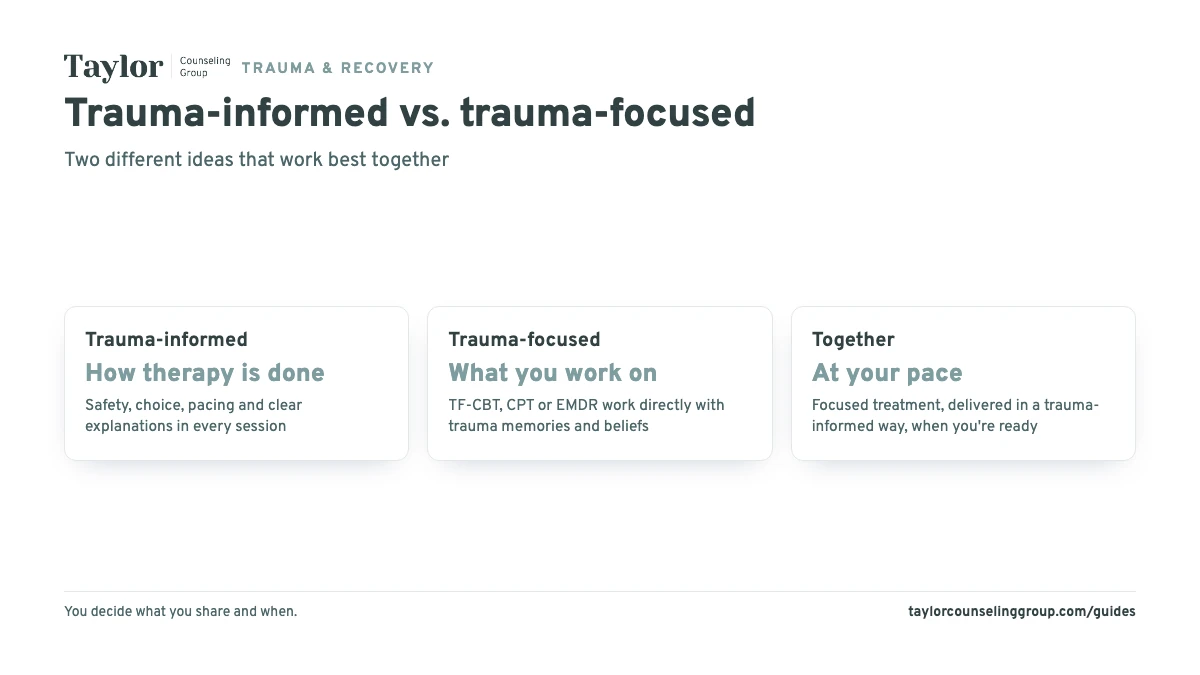
Trauma-informed describes how therapy is done. Trauma-focused describes what you work on: structured treatments that deal directly with the traumatic memories, and the beliefs that grew out of them.
The main trauma-focused treatments you’ll hear about are:
- Trauma-Focused Cognitive Behavioral Therapy (TF-CBT). A step-by-step approach that teaches coping skills, then helps you gradually make sense of what happened and how it changed your thinking. It’s often used with children and teens, with a parent or caregiver involved.
- Cognitive Processing Therapy (CPT). A form of CBT that helps you notice and question “stuck points,” like “It was my fault” or “I can’t trust anyone.” On average, CPT runs 12–16 individual hour-long sessions. Our Cognitive Processing Therapy page explains each step.
- EMDR (Eye Movement Desensitization and Reprocessing). A therapy that helps you process difficult memories and reduce their emotional charge, using back-and-forth eye movements, taps or sounds while you briefly hold a memory in mind. Our blog post Does EMDR Really Work? The Science and Results of Trauma Therapy goes deeper.
The two ideas fit together. A good trauma-focused treatment is delivered in a trauma-informed way: you’re prepared, you consent to each step and you set the pace. And a trauma-informed therapist doesn’t have to be doing a trauma-focused treatment at all. They might be helping you with anxiety, sleep or grief, while staying aware of how your history shows up.
Do I have to talk about what happened in detail?
No. Not in the first session, and not until you’re ready. “I’m not ready to talk about that yet” is a complete answer, and a trauma-informed therapist will take it at face value.
Early sessions are usually about getting to know you, understanding what’s hard right now and building tools you can use when a memory or trigger hits.
That said, trauma-focused work does eventually move toward the memories, slowly and with your permission. Here’s why: avoiding reminders feels protective in the moment, but over time it tends to keep trauma reactions going. The goal is to approach what’s been avoided in small, manageable steps, with support, until it loses some of its grip. A trauma-informed therapist makes sure you understand that plan, agree to it and know you can pause it.
Get matched with a therapist
Easily schedule your appointment online at one of our locations in Central Texas.
What is retraumatization, and how does a trauma-informed therapist avoid it?
Retraumatization is when something in the present makes you feel the way you felt during the trauma: powerless, trapped, ambushed, blamed or not believed.
Trauma-informed therapists work hard to keep that from happening. You’ll usually see them:
- Ask before going deeper instead of pushing for details.
- Agree on a stop signal, a word or gesture that means “let’s pause.”
- Check in often about how you’re doing, in your body as well as your thoughts.
- Leave time at the end so you can settle before you walk back out into your day.
- Believe you. Your experience isn’t put on trial or ranked against anyone else’s.
If something in a session does stir you up, that’s useful information, not a failure. Tell your therapist so the two of you can adjust together.
Who is trauma-informed therapy for?
Pretty much anyone. You don’t need a formal diagnosis, or a “big enough” event, to begin therapy; trauma is about how an experience landed in you, not how it ranks against anyone else’s. And trauma is common. A CDC survey of U.S. adults in all 50 states and the District of Columbia, covering 2011–2020, found that 63.9% reported at least one adverse childhood experience, such as abuse, seeing violence between adults at home or living with someone who misused alcohol or drugs, and about one in six reported four or more. And according to the VA’s National Center for PTSD, about 6 out of every 100 people in the U.S. will have PTSD at some point in their lives.
People come to trauma-informed therapy after many kinds of experiences:
- A single event, like a car crash, an assault or a natural disaster.
- Complex or ongoing trauma, such as years of abuse, neglect or living with constant fear.
- Childhood trauma that still shapes adult life. Our blog post Healing Childhood Trauma as an Adult talks about this.
- A toxic or controlling relationship, including the pull of trauma bonding. See our post Trauma Bonding: What It Is and How to Heal From It.
- Military service, deployment or coming home. Our veteran counseling supports service members, veterans and their families.
- Discrimination or racial trauma.
Signs you may benefit from trauma recovery counseling include emotional struggles, intrusive thoughts, trust issues, anxiety, avoidance, guilt and physical symptoms like fatigue. Trauma can also look like constant stress or a low mood that won’t lift. If that sounds familiar, our guides on How to Tell If Stress Is Affecting Your Daily Life and How Counseling Can Help With Depression may help you sort out what you’re feeling.
What happens in a first session with a trauma-informed therapist?
Your first session is mostly about getting to know you and giving you space to talk. It lasts about an hour. A trauma-informed therapist will usually:
- Explain how confidentiality works and what the session will look like, so nothing comes as a surprise.
- Ask what brought you in, and let you choose how much detail to give.
- Tell you it’s fine to skip any question on the intake forms or in the room.
- Ask what you’d like to be different, so you can start setting goals together.
- Make sure you feel steady before you leave.
Feeling a little shaky afterward is normal. For a step-by-step look, read our guide What Should I Expect in My First Therapy Session?

How can I tell if a therapist is really trauma-informed?
“Trauma-informed” shows up on a lot of profiles. The best way to know what it means for a specific therapist is to ask. Good questions for a consultation or first session:
- “How do you decide when we start talking about the trauma itself?”
- “What happens if I get overwhelmed in a session?”
- “Which trauma-focused approaches are you trained in, and how would we choose one?”
- “Can I say no to an exercise, or stop partway through?”
Green flags: they explain things clearly, invite your questions, ask permission, talk about pacing and coping skills, and treat your goals as the starting point.
Red flags: they push for details right away, brush off your concerns, judge how you’ve coped, or can’t explain why they’re doing what they’re doing.
Fit matters, too. If you don’t feel comfortable with a therapist after your first few sessions, that’s not on you. You can browse our therapists, and if you’re using insurance, our guide How Do I Find an In-Network Therapist? walks you through the search.
Does trauma-informed therapy consider my culture, identity and faith?
It should. Ethnicity, identity, gender, sexual orientation and other parts of who you are can shape what happened to you, how it affected you and what healing looks like. Recognizing that head-on can be an important part of reclaiming your voice.
In practice, your therapist asks rather than assumes what safety, family and recovery mean in your world.
If a particular kind of support matters to you, say so when you get matched. We offer LGBTQ counseling, faith-based counseling on request and racial identity counseling.
What if therapy starts to feel like too much?
Trauma work can stir things up. Some weeks you may leave a session feeling lighter, and others you may feel tired, emotional or on edge for a day or so. That’s a normal part of the process, and it’s something to bring up with your therapist, not something to push through alone.
When it happens, a trauma-informed therapist will slow down. You might spend a few sessions back on grounding and coping skills, change the order of your goals, or take a break from the hardest material until you feel steadier. You can also plan together for between sessions: who to call and what helps you calm down.
Get matched with a therapist
Easily schedule your appointment online at one of our locations in Central Texas.
Can children and teens get trauma-informed therapy?
Yes. Kids feel trauma too, though it often shows up as behavior instead of words: trouble sleeping, clinginess, angry outbursts, stomachaches or acting younger than their age. A trauma-informed counselor reads those signs with care and keeps the child’s sense of safety at the center.
For children and teens, TF-CBT is built to include a parent or caregiver, so you learn how to support your child at home while they build skills in session. Younger children often do their best work through play, since play is how kids naturally process the world. Our guide Is Play Therapy Right for My Child? explains how that works.
You don’t have to know which approach your child needs. Tell us what you’re seeing, and we’ll help you find a good fit.
Trauma-informed therapy with us in Texas
Our trauma recovery counseling is trauma-informed from the first call, and we have clinicians trained in TF-CBT and CPT, along with therapists trained in EMDR, in person or online.
We see clients at ten locations in Texas and online on a secure, HIPAA-compliant video platform, with no extra cost for telehealth. Our standard private rate is $130 per session, we’re in-network with most major insurance plans (see our Insurance & Payment page), Tricare and TriWest are options for military families, and our income-based Affordable Care Program offers lower rates.
A made-up example: what trauma-informed therapy can look like after a car crash
Here’s an illustration with a made-up person. Dana was rear-ended on the highway. She wasn’t badly hurt, but months later she’s taking back roads to work, jumping at sudden noises and sleeping badly.
- First session: her therapist explains how sessions work, asks what’s hardest right now and tells Dana she doesn’t need to describe the crash until she wants to. They agree on a stop signal.
- Next few sessions: they work on sleep and on grounding skills Dana can use in the car. Dana sets her own goals: sleep through the night and drive her normal route again.
- Choosing a path: her therapist explains the options, including CPT and EMDR, how each works and what it asks of her. Dana picks one, knowing she can slow down at any point.
- A harder week: one session leaves her rattled, so they spend the next one back on coping skills.
What made Dana’s therapy trauma-informed wasn’t one technique. It was that she always knew what was happening, chose each step and set the pace.
Frequently asked questions
Is trauma-informed therapy the same as EMDR?
No. EMDR is one trauma-focused treatment, alongside TF-CBT and CPT. Trauma-informed describes the way therapy is done, and a good EMDR, TF-CBT or CPT therapist works in a trauma-informed way.
Can trauma-informed therapy be done online?
Yes. Online sessions take place on a secure, HIPAA-compliant video platform, and our therapists can provide EMDR online. There’s never an extra cost to see your counselor by telehealth.
How long does trauma-informed therapy take?
It depends on your goals and needs. Treatment can range from a couple of sessions to years, and you and your therapist will check in on progress and adjust the plan as you go.
Does insurance cover trauma-informed therapy?
We’re in-network with most major insurance plans, and our support staff will verify your benefits before your first session. Verifying benefits doesn’t guarantee payment, so it’s worth checking your plan too. Our Insurance & Payment page explains how it works.
Can couples or families get trauma-informed counseling?
Yes. Trauma often affects the people closest to you, and a trauma-informed approach can shape individual, couples or family counseling. Tell us who you’d like to include when you get matched.
What if I tried therapy before and it didn't help?
That’s common, and it doesn’t mean therapy can’t help you. Tell your new therapist what didn’t work, whether it was the pace, the fit or the approach, so you can plan something different together.
Key takeaways
- Trauma-informed therapy is an approach built on safety, choice, pacing, openness and collaboration, not one specific technique.
- Trauma-focused treatments like TF-CBT, CPT and EMDR work directly on trauma, and they’re best delivered in a trauma-informed way.
- You never have to share details before you’re ready, and you can always ask to slow down.
- You don’t need a diagnosis or a “big enough” event to start therapy.
- Ask a therapist how they handle pacing and overwhelm; their answer tells you a lot about fit.
You deserve affordable, reliable, & accessible care
We accept most major insurances and are dedicated to providing high-quality services at affordable rates. Our support staff is available to answer any questions you may have.
Sources
- Trauma-Informed Approaches and Programs — Substance Abuse and Mental Health Services Administration (SAMHSA)
- TIP 57: Trauma-Informed Care in Behavioral Health Services — SAMHSA Library
- Prevalence of Adverse Childhood Experiences Among U.S. Adults — Behavioral Risk Factor Surveillance System, 2011–2020 — CDC, Morbidity and Mortality Weekly Report
- How Common is PTSD in Adults? — U.S. Department of Veterans Affairs
- Trauma-Informed Care — The National Child Traumatic Stress Network

Dr. Christopher Taylor
Christopher S. Taylor, Ph.D., is the founder of Taylor Counseling Group, an existential psychotherapist and the author of You Are Here. A Board-Approved LPC Supervisor, he was appointed by Governor Greg Abbott to the Texas State Board of Examiners of Professional Counselors, where he was later elected Vice Chair.
This guide is general information from Taylor Counseling Group. It is not medical advice, a diagnosis or a substitute for care from a licensed mental health professional, and reading it does not create a counseling relationship. If you are in danger or need help right away, call 911 or go to the nearest emergency room.