
What is the difference between play therapy and talk therapy for kids?

- Play therapy or talk therapy: which one fits my child’s age and personality?
- What does play therapy look like for a child?
- What does talk therapy look like for a kid or teen?
- Why can’t younger kids just talk it out?
- Which ages usually fit each approach?
- Does what your child is going through change the choice?
- Can a therapist mix play and talk in the same session?
- How involved are parents in each one?
- What does research say about which one works better?
- What if your child refuses to talk, or won’t stop talking?
- How long does each kind of therapy take?
- What does it cost, and does insurance help?
- How do you get started and choose the right fit?
- What’s different for families in Texas?
- A worked example: one made-up family weighing play or talk
- Frequently asked questions
- Key takeaways
- More in this section
- Sources
The short version
- Play therapy: toys, art and sand tray work stand in for words, usually for kids about 5 to 12.
- Talk therapy: conversation and skill practice, usually for older kids and teens.
- Plenty of sessions mix both, especially in the tween years.
- Parents are involved in both, but more directly when the child is young.
For parents in Texas trying to figure out whether their child would do better with toys and art in the room, a conversation with a counselor, or a bit of both.
Play therapy or talk therapy: which one fits my child’s age and personality?
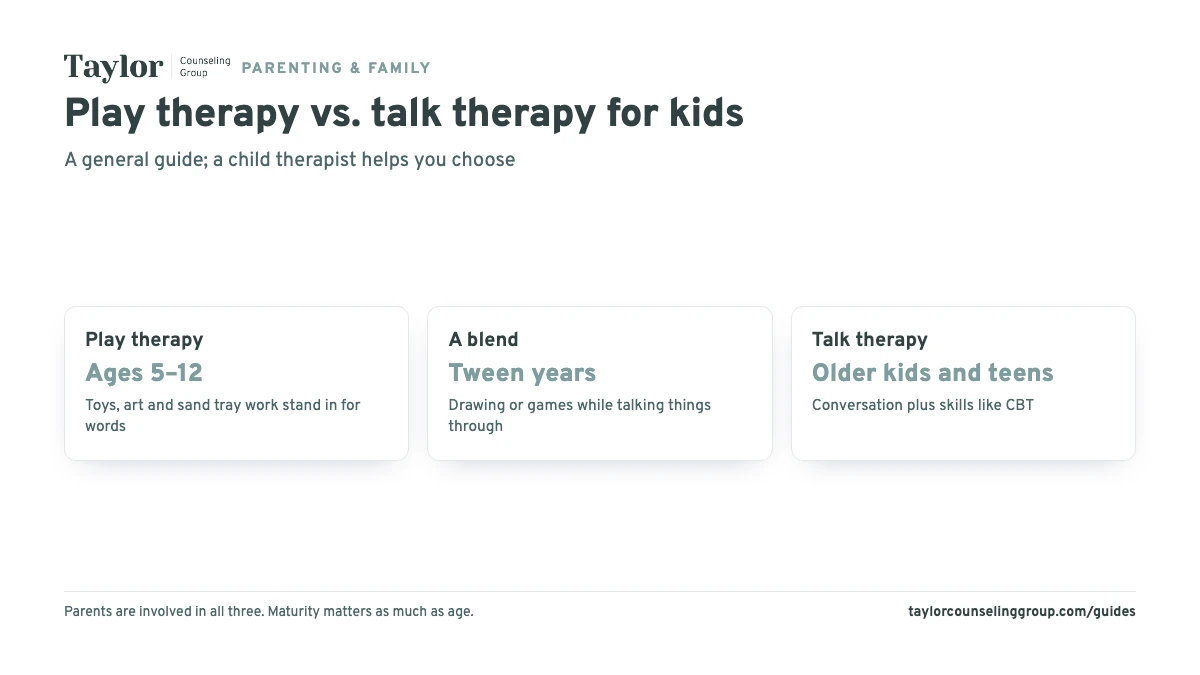
Play therapy uses toys, art, puppets and sand tray work as a child’s way of saying what they can’t yet put into words, and it’s typically for kids about 5 to 12. Talk therapy uses conversation to help a child or teen name feelings, spot unhelpful thoughts and practice new skills, so it tends to suit older kids and teens who can reflect out loud. Many therapists blend the two, and the right fit depends less on the label than on your child’s age, how easily they talk about feelings and what they’re going through.
Not sure which way to go? Our play therapy for children is built for kids about 5 to 12, and our counselors also see older kids and teens in individual counseling. When the struggle runs through the whole household, family counseling brings everyone into the work, from parenting skills to bigger family conflicts. For more questions like this one, browse our Parenting & Family guides.
What does play therapy look like for a child?
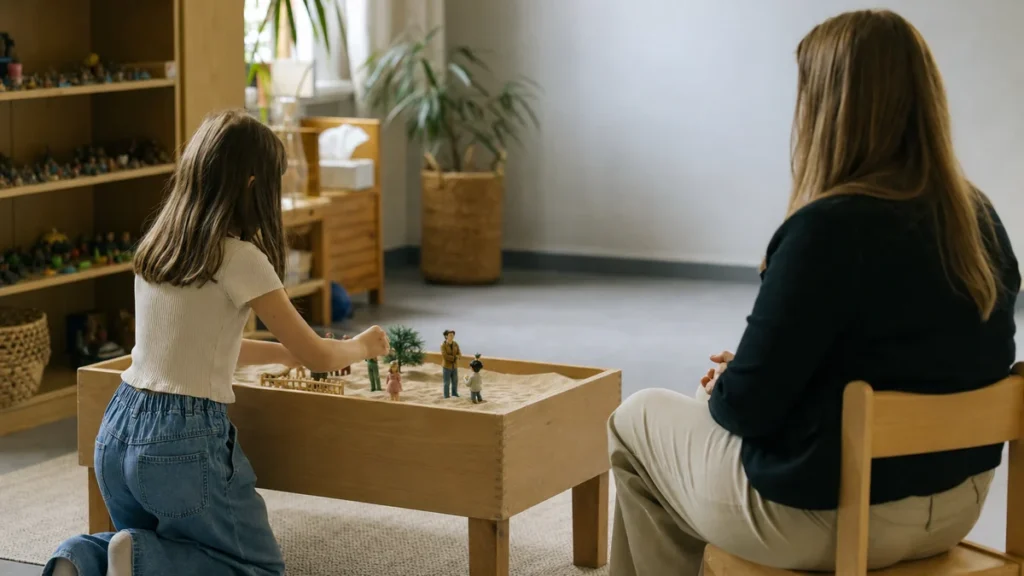
Picture a bright room with shelves of small figures, puppets, a dollhouse, art supplies and a sand tray. Your child picks what to play with, and a trained therapist plays alongside, watches closely and gently reflects what’s happening. That’s play therapy.
It works because play is how kids naturally make sense of their world. In the playroom, toys act like words and play acts like sentences. The toy family that keeps getting split into two houses, the dinosaur who’s always left out, the drawing that’s all one color: these themes tell the therapist a lot about what your child is carrying.
From there, the therapist uses play to help your child name feelings, try new ways to cope and practice them. A puppet show might rehearse what to do when a friend says something mean. A board game might become a safe way to practice losing without a meltdown. To your child, it mostly feels like a fun hour with a grown-up who really gets them. For a closer look at the fit questions, read Is Play Therapy Right for My Child?
What does talk therapy look like for a kid or teen?
Talk therapy is what most people picture when they think of counseling: sitting with a therapist and talking through what’s hard. For kids and teens, it’s a lot less formal than it sounds. Sessions are relaxed, the therapist leads with curiosity, and nobody’s grading the answers.
A big part of talk therapy for young people is skill-building. In cognitive behavioral therapy (CBT), for example, a child learns how thoughts, feelings and actions feed each other. They practice catching a thought like “Everyone hates me,” checking whether it’s really true, and swapping in something more accurate. Other sessions focus on problem-solving, handling big emotions, friendships or stress at school.
Talk therapy also gives older kids something they really want: a private space with an adult who isn’t their parent. A teen who rolls their eyes at a lecture at home will often open up to someone neutral who listens without reacting.
Why can’t younger kids just talk it out?
Because their brains aren’t built for it yet. Ask a six-year-old why they’ve been hitting their sister, and you’ll probably get “I don’t know” or a shrug. That isn’t stubbornness. Young kids feel big things, but they don’t have the vocabulary or the step-back thinking to explain them on demand.
Talking about feelings means noticing an emotion, naming it, linking it to a cause and describing it. Those skills grow slowly through the grade-school years. Until then, feelings tend to come out through behavior: meltdowns, clinginess, stomachaches or trouble sleeping.
Play meets kids where they are. A child who can’t say “I’m scared Dad won’t come back” can still show it by making the toy dad drive away again and again. Play therapy gives those feelings a voice without asking your child to find words they don’t have yet.
Which ages usually fit each approach?
Age is a starting point, not a rule. Here’s the general pattern:
- Younger grade-schoolers. Play therapy is typically for children 5 to 12, and it tends to be the natural fit at the younger end of that range, when words are still catching up with feelings.
- The tween years. This is the in-between zone. Many kids this age do best with a blend: drawing, games or building with their hands while they talk. Some want to talk; others still need the playroom when a subject gets heavy.
- Teens. Most teens do well with talk therapy, often with skills practice built in. Some still like something in their hands, like a fidget, a sketchpad or a card game, which can make talking feel less intense.
Maturity matters as much as the number on the birthday cake. A very verbal eight-year-old may enjoy talking things through, while a quiet eleven-year-old who’s been through a lot may open up more easily in the playroom.
Does what your child is going through change the choice?
Yes. The concern itself often points the way, and a child therapist weighs it with you. A few common situations:
- A big change or loss. Divorce, a death in the family, a move or a hospital stay can shake a child’s sense of safety. Younger kids often process those changes best through play. If your family is navigating a split, see How Counseling Can Help You Stay United for Your Kids After Divorce.
- Worry and anxious thoughts. Older kids and teens often do well learning CBT skills in conversation. With younger kids, the same ideas can be taught through games, stories and puppets.
- Behavior that’s taking over home life. When the hard moments mostly happen between you and your child, Parent-Child Interaction Therapy (PCIT), a family counseling approach that focuses on the parent-child relationship and healthy interactions, may fit better than either one alone.
- Attention and focus struggles. For kids with ADHD, we offer non-medication options, including behavioral therapy, CBT and skill-building strategies.
- Tension across the household. If it’s really about how everyone gets along, family therapy, with the whole family or a few willing members, may be the better first step. Combining two households? Read What Is a Blended Family, and When Counseling Helps.
You don’t need a formal diagnosis to get started.
Get matched with a therapist
Easily schedule your appointment online at one of our locations in Central Texas.
Can a therapist mix play and talk in the same session?
All the time. The line between the two is much blurrier in real sessions than it looks on paper. A play therapist talks with your child, and a counselor seeing a ten-year-old will often pull out markers, a sand tray or a game when conversation stalls.
A blend can look like:
- Drawing a “worry monster,” then talking about how to talk back to it
- Building a sand tray scene, then telling its story
- Acting out a hard conversation with puppets before trying it for real
Good child therapists read the room and shift gears when your child does. So you don’t have to pick the perfect label up front. What matters most is a therapist trained to work with kids your child’s age.
How involved are parents in each one?
In both, you’re a key part of the team. The difference is how. Parent involvement matters at every age, but it changes shape as kids grow.
- With young kids in play therapy, your child usually has the playroom to themselves, and the therapist checks in with you regularly about themes, progress and what to try at home. Some therapists invite parents into certain sessions to practice skills together.
- With teens in talk therapy, sessions are mostly one-on-one, and privacy matters more. Expect updates on overall progress and any safety concerns, while the day-to-day details stay between your teen and their therapist. That privacy is often what lets teens be honest.
- In the middle years, it’s usually a mix: mostly solo sessions, with family check-ins along the way.
Whatever the age, your therapist works with you on a personalized treatment plan with goals you understand. Ask at the start how updates will be shared, so everyone knows what to expect.
What does research say about which one works better?
There isn’t a simple winner, because they’re often used for different kids and different problems. The CDC notes that for the most common childhood concerns, such as behavior disorders, anxiety and depression, approaches that use behavior therapy and CBT are more likely to reduce symptoms than other approaches. Parent training in behavior management works well for disruptive behavior disorders. Other approaches may also work but haven’t been studied enough to know, and information on what works best for which family is still limited.
For you, that means the skills taught and who’s involved matter more than the format. With a seven-year-old, CBT-style ideas often come through play and stories; with a fifteen-year-old, through conversation.
So instead of asking “play or talk?”, try asking a therapist: “What skills will my child learn, how will you teach them at my child’s age, and how will I be involved?”

What if your child refuses to talk, or won’t stop talking?
Both are more common than you’d think, and neither is a problem for a good child therapist.
The quiet kid. Some kids, and plenty of teens, clam up the moment an adult asks how they feel. Pressure makes it worse. Play, drawing or a game side by side takes the spotlight off them, and talking often follows once they feel safe. Even teens may start with activities before conversation feels comfortable.
The chatterbox. Some young kids talk nonstop, but mostly about video games or their dog. That’s okay. A skilled therapist uses the chatter to build trust, then steers toward what matters, often with play.
How long does each kind of therapy take?
It depends on your child and what’s going on. Typically, children do play therapy for two to twelve months, depending on how complex or severe the concerns are. For talk therapy, treatment can range from a couple of sessions to years, depending on goals and needs. Most of our in-person and online sessions last about an hour.
How long the struggle has lasted, whether something hard is still happening and how much new skills get practiced at home all shape the pace. Ask early: what changes should we notice first, and how will we know when it’s time to wrap up?
What does it cost, and does insurance help?
Whichever approach fits, you have three ways to pay with us.
- Insurance. We’re in-network with most major insurance plans. With a plan we accept, your out-of-pocket cost is typically a copay or co-insurance once your deductible is met. Our support staff will check your benefits for you. A benefits check isn’t a promise of payment, and you’re responsible for the full cost of sessions if your plan doesn’t pay. See insurance and payment for details.
- Private pay. Our standard private rate is $130 per session.
- Affordable Care Program. Our income-based program offers sessions with Counselor Associates from $50 per hour session and with Practicum Students from $30 per hour session, under a Board Approved Professional Supervisor. This program doesn’t use insurance.
There’s no additional cost to see a counselor by telehealth. If you’re feeling stretched yourself, How to Tell if Stress Is Affecting Your Daily Life is worth a read too.
How do you get started and choose the right fit?
- Jot down what you’re seeing. When it started, where it shows up (home, school, friends) and what you’ve tried. This helps a therapist recommend play, talk or a blend.
- Get matched. Fill out the Get Matched form and choose “For My Child (under 18).” You can also find a location near you.
- Ask for a consultation if you’d like one. You can schedule a consultation for your child before scheduling an appointment, and talk through which approach makes sense.
- Complete the paperwork. Intake forms are completed online at least 24 hours before the first appointment, including a Consent for Treatment of a Minor form.
- Give it a few sessions. The first session is mostly about getting to know you and your child. If the therapist isn’t the right match, our team will help you move to another provider in our group.
Find a location near you
We provide affordable, reliable, and accessible care across Central Texas. Find a location near you.
What’s different for families in Texas?
Texas requires custody documents or a current court order verifying your authority to consent to your child’s treatment, so if you’re divorced, separated or a guardian, gather those papers before the first visit. We serve clients from age five through late adulthood at ten locations in Texas, plus online, so the same practice can see your younger child in the playroom, your teen in individual counseling and your whole family together when that helps.
A worked example: one made-up family weighing play or talk
Here’s an illustration with a made-up family, not a real client. Maya is 10. Since starting a new school, she’s had stomachaches most mornings and cries at drop-off. She’s chatty and bright, but when her dad asks what’s wrong, she says she doesn’t know.
Run through the factors above. Maya is in the in-between years. She talks easily about most things but not about her worries, which suggests a blend could suit her: some drawing or games to get the feelings out, and some CBT-style talk to learn how worried thoughts work and what to do about them. Her dad would likely get a few check-ins with tips for calmer mornings. A child therapist is the one to confirm what fits, so her dad books a consultation and tells Maya she’ll meet someone whose job is helping kids with worries.
Frequently asked questions
Is play therapy just playing?
It looks like play, but the therapist is trained to read what your child’s play is saying and guide it toward naming feelings and practicing new ways to cope.
Can a teenager do play therapy?
Play therapy is typically for kids 5 to 12, but some teens still benefit from art, sand tray work or games, especially when talking feels like too much. A therapist can blend those in.
Will my child have to talk about the hard stuff right away?
No. Early sessions focus on trust, and children move at their own pace. Your child can always say they’re not ready to talk about something yet.
Can my child do either kind online?
Our online sessions take place on a secure, HIPAA-compliant video platform, and older kids and teens often do well with them. For younger kids who need the playroom, ask whether in-person sessions are the better fit.
Is play therapy less serious than talk therapy?
Not at all. It’s a different way of doing the same work, matched to how younger kids think and communicate.
Can my child switch from play therapy to talk therapy later?
Yes. As kids grow and get more comfortable with words, many therapists naturally shift toward more conversation. Your child’s therapist will talk with you about when that makes sense.
Key takeaways
- Play therapy uses toys, art and sand tray work in place of words and is typically for kids 5 to 12.
- Talk therapy uses conversation and skills practice and tends to suit older kids and teens.
- Many sessions blend both, especially in the tween years, so you don’t need the perfect label up front.
- What your child is going through, and how easily they talk about feelings, matter as much as age.
- Parents are involved either way; a consultation is an easy first step.
Getting the help you need shouldn't be complicated
So we make scheduling an appointment easy with our online booking tool.
More in this section
- What is a blended family, and when counseling helps?
- How can counseling help us stay united for our kids after divorce?
- Is play therapy right for my child?
Sources
- Treating Children's Mental Health with Therapy — Centers for Disease Control and Prevention
- Psychotherapy for Children and Adolescents: Different Types — American Academy of Child and Adolescent Psychiatry
- What is Play Therapy? — Center for Play Therapy, University of North Texas
- Play Therapy Makes a Difference — Association for Play Therapy
- Teen Mental Health Support 101: Types of Treatment & How to Get Help — HealthyChildren.org (American Academy of Pediatrics)

Dr. Christopher Taylor
Christopher S. Taylor, Ph.D., is the founder of Taylor Counseling Group, an existential psychotherapist and the author of You Are Here. A Board-Approved LPC Supervisor, he was appointed by Governor Greg Abbott to the Texas State Board of Examiners of Professional Counselors, where he was later elected Vice Chair.
This guide is general information from Taylor Counseling Group. It is not medical advice, a diagnosis or a substitute for care from a licensed mental health professional, and reading it does not create a counseling relationship. If you are in danger or need help right away, call 911 or go to the nearest emergency room.