
Does couples counseling work?


- Does couples or marriage counseling actually help most couples?
- So, does couples counseling actually work?
- What does it look like when couples counseling is working?
- What makes couples counseling more likely to help?
- Is it too late if we've been unhappy for years?
- Which approaches do couples counselors use, and does the method matter?
- When does couples counseling work less well?
- What if my partner doesn't want to go?
- How long until we notice a difference?
- Can couples counseling help after an affair or a breach of trust?
- Is couples counseling only for relationships in crisis?
- How do we give counseling the best chance from the first session?
- Starting couples counseling in Texas
- A made-up example: the fight that's never really about the dishes
- Frequently asked questions
- Key takeaways
- More in this section
- Sources
The short version
- Studies of couple therapy find large gains in relationship satisfaction, plus better communication and closeness, that generally last.
- It works best when both of you take part, start sooner rather than later and practice between sessions.
- Long-standing distress doesn't rule you out; couples who start out more distressed often gain the most.
- You don't need to pick a method first; your counselor builds a plan around your goals.
For couples in Texas, married, engaged or dating, who are wondering whether counseling is worth trying before they reach out.
Does couples or marriage counseling actually help most couples?
For many couples, yes. Research on couple therapy finds large improvements in relationship satisfaction, along with real gains in communication and emotional closeness, and those gains generally hold after counseling ends. It isn’t a promise for every relationship: it tends to go best when both partners take part, start before resentment sets in hard, and practice what they learn between sessions. Whether it will help the two of you depends on what you’re facing, and a first few sessions with a couples counselor is the clearest way to find out.
If you’re ready to see whether counseling can help the two of you, our couples counseling therapists will start where you are, in person or online. Not sure whether you need couples or individual therapy first? Our blog walks through Individual Therapy vs. Couples Therapy, and the rest of our Relationships & Couples guides answer the next questions couples usually ask.
So, does couples counseling actually work?
Yes, for a lot of couples it does. A 2020 meta-analysis of 58 couple therapy studies found that couple therapy has a large effect on relationship satisfaction, while couples placed on a waitlist didn’t significantly improve. Therapy also made a real difference in communication, emotional intimacy and how partners treated each other, and the gains were generally maintained over both short- and long-term follow-up.
That’s the big picture. Your relationship isn’t an average, though, so the more useful question is what makes counseling more or less likely to help you. That comes down to a handful of things you can actually influence: whether you both show up ready to work, when you start, what you’re working on and how well you fit with your counselor.
One thing to know about that research: the review only included opposite-sex couples. Our couples counseling is inclusive of all couples, including same-sex partners, and the skills you build in sessions, like listening without defending and repairing after a fight, belong to every relationship.
What does it look like when couples counseling is working?
Couples sometimes picture “success” as one big breakthrough moment. It’s usually quieter than that. Signs that counseling is doing its job:
- Fights cool down faster. You still disagree, but a spat about the dishes doesn’t turn into a three-day freeze.
- You feel heard more often. You can say what’s bothering you without it instantly becoming an argument about who’s right.
- You repair sooner. One of you reaches out after a rough moment, and the other can meet them there.
- Old topics feel less loaded. Money, in-laws or the chore list become problems you solve together instead of landmines.
- You understand the pattern. You can name the cycle you fall into, like one of you pushing and the other pulling away, and catch it earlier.
Counseling can also bring clarity about what each of you really wants. Your counselor won’t make decisions for you; they help you both see things clearly so you can decide together.
What makes couples counseling more likely to help?
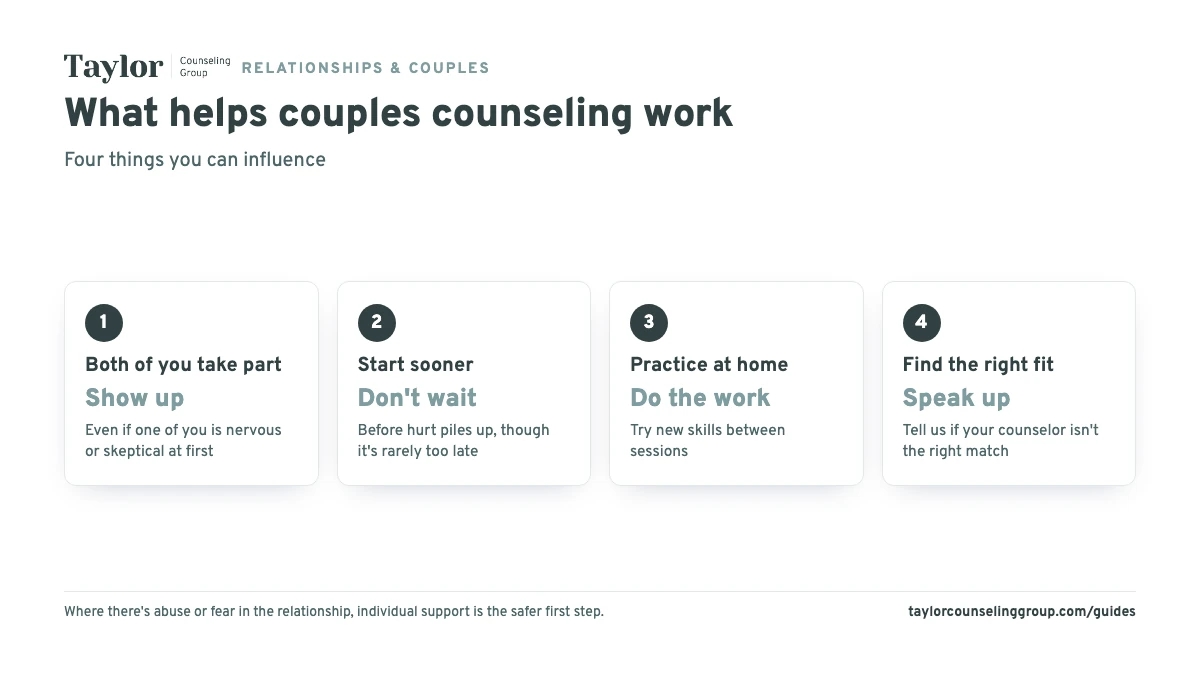
Here’s what tends to tip the odds in your favor:
- Both of you take part. Couples sessions are typically held with both partners present, and progress depends on both of you engaging, even if one of you is nervous or skeptical at first.
- You’re honest in the room. Your counselor can only work with what they know. Holding back the real issue keeps the sessions on the surface.
- You practice between sessions. Your counselor can’t do the work for you. The conversation you try at home on a Tuesday night matters as much as the hour in the office.
- You give it time. Problems won’t be fixed in the first session; it takes time and commitment from both of you to see a difference.
- The fit feels right. You both need to feel the counselor is fair and understands you. If it doesn’t feel right after the first few sessions, say so. Our team will help you move to another provider in the group who fits better.
None of these require you to feel hopeful on day one. Plenty of partners walk in unsure the relationship can change. Willingness to show up and try is enough to start.
Is it too late if we've been unhappy for years?
Not necessarily. It’s one of the most common worries, and the research is more encouraging than you might expect. Couples who start out with greater distress tend to make larger gains in relationship satisfaction. A 2023 meta-analysis of 48 studies of couple therapy in everyday clinic settings found improvement in both relationship and individual outcomes, with results that varied a lot from study to study; in its relationship outcomes, studies with older couples and longer relationships tended to do better.
So a long, rough stretch doesn’t mean you’ve missed your window. What matters more is whether you’re both still willing to try. Patterns that have had years to settle in can take longer to shift, so be patient with the pace and talk with your counselor about how it’s going along the way.
Which approaches do couples counselors use, and does the method matter?
Our couples counselors use EFT, CBT and the Gottman Method, along with other approaches, to improve communication and strengthen your relationship. In plain terms:
- Emotionally Focused Therapy (EFT) looks at the emotional cycle underneath your fights, like one partner feeling shut out and the other feeling criticized, and helps you reach for each other in a new way.
- Cognitive behavioral therapy (CBT) works on the thoughts and habits that drive conflict, such as assuming the worst about your partner’s motives, and builds practical communication and problem-solving skills.
- The Gottman Method focuses on concrete relationship skills: managing conflict, building friendship and fondness, and repairing after a hurtful moment.
Each approach has its own research behind it. EFT, for example, was the subject of a 2024 meta-analysis covering 20 studies, which found that 70% of couples were symptom free at the end of treatment, with gains lasting up to two years.
You don’t need to pick a method before you start. Many counselors blend tools from more than one approach, and the right one depends on what you’re working on. What you’ll notice most is whether your counselor helps you both feel safe enough to say the real thing. Your therapist will work with you on a personalized treatment plan built around your goals.
Get matched with a therapist
Easily schedule your appointment online at one of our locations in Central Texas.
When does couples counseling work less well?
Couples counseling is a strong tool, not a magic one. It tends to struggle when:
- One partner has already decided to leave and is using sessions to soften the news rather than to work on things.
- There’s an ongoing secret, like an affair that’s still happening, that keeps the real issue out of the room.
- Only one person is doing the work, week after week, while the other waits for them to change.
- Sessions become a scorecard, where each of you brings a list of the other’s mistakes instead of looking at the pattern you share.
If any of these sound familiar, it doesn’t automatically mean counseling won’t help. Saying it out loud to your counselor is often where the real work begins.
Safety is different. If there’s current abuse, coercive control or fear of retaliation in the relationship, couples counseling may not be the right first step. Individual support is the safer place to start.
What if my partner doesn't want to go?
It’s natural for one partner to be hesitant. Some worry they’ll be blamed. Others feel embarrassed, or think talking to a stranger about private things will make it worse. Try talking about those worries openly, and explain that counseling is a space where both voices are heard, not a trial where one of you is found guilty.
A few things that help a reluctant partner:
- Ask for a small step. “Will you come to one or two sessions and see what it’s like?” is easier to agree to than “we need therapy.”
- Name what you want, not what’s wrong with them. “I want us to stop fighting about money” lands better than “you never listen.”
If your partner still isn’t ready, you can start with individual counseling. You can work on how you show up in the relationship, how you handle conflict and what you need, and bring your partner in later if they decide to join. If worry about the relationship keeps looping in your head while you wait, our guide on How to Stop Overthinking in a Relationship has things you can try.
How long until we notice a difference?
There’s no set timeline. Treatment can range from just a couple of sessions to years, depending on your goals and needs. Learning to argue more fairly about chores is a very different job from rebuilding trust after a betrayal.
Some couples feel a little relief early, simply because they finally have a calm place to talk. Deeper change usually takes longer, because you’re practicing new habits until they become the default. A few things shape the pace:
- What you’re working on and how long it’s been going on.
- How often you come. Many couples start weekly while things are tense, then space sessions out once they’re using new skills on their own.
- How much you practice between sessions.
After the first couple of sessions, ask your counselor what a rough plan looks like and when you’ll check how it’s going. You stay in charge of the pace. If cost is part of the timing question, our guide on How Much Couples Counseling Costs in Texas walks through private pay, insurance and income-based rates.
Can couples counseling help after an affair or a breach of trust?
Trust and intimacy are some of the most common reasons couples come to counseling, including repairing trust after a significant rupture. It’s slow, careful work, and it asks something different of each partner.
The partner who was hurt needs room to ask questions and express pain without being rushed toward forgiveness. The partner who broke trust needs to stay present for those conversations without getting defensive, and to show change through consistent actions over time. Your counselor keeps those conversations from spiraling and helps you both understand what led to the breach, without excusing it.
Is couples counseling only for relationships in crisis?
Not at all. Plenty of couples come when things are mostly good and they want to keep them that way, or when a big change is coming: a wedding, a new baby, a move, a blended family. Working on communication before problems pile up is often easier than untangling them later.
Engaged couples often choose premarital counseling, which is more structured and focused on expectations, money, family and conflict styles before marriage. Our guide to What Premarital Counseling Is and What Happens in It covers that. If you’re bringing kids from earlier relationships together, our guide on Blended Families and When Counseling Helps is a good next read.
Couples counseling is also for couples who aren’t married: dating, living together, engaged, same-sex or different-sex. If you’re in a relationship you care about, you’re in the right place.
How do we give counseling the best chance from the first session?
Your first session is mostly about getting to know you both and giving you space to talk. Your counselor may ask how you met, what’s going well and what brought you in. You don’t need a formal diagnosis to begin, and you don’t need to have the perfect words.
A few habits make each session count:
- Talk before you go. Agree on one or two things you most want to work on, even if you see them differently.
- Bring real examples. “We fought about my mom’s visit on Sunday” gives your counselor more to work with than “we don’t communicate.”
- Ask how they work. Policies on confidentiality, individual meetings and secrets vary by therapist, so ask early so you both understand the ground rules.
- Say what’s not working. Feedback helps your counselor adjust, and it’s a great way to practice the honesty you’re building.
Get matched with a therapist
Easily schedule your appointment online at one of our locations in Central Texas.
Starting couples counseling in Texas
We have ten locations in Texas plus online sessions on a secure, HIPAA-compliant video platform, at no extra cost. Our standard private rate is $130 per session, we’re in-network with most major insurance plans (see our Insurance & Payment page), and our income-based Affordable Care Program is there if cost is the thing holding you back. If faith matters to you, or LGBTQIA+ affirming care is important, you can tell us when you get matched and we’ll keep it in mind.
A made-up example: the fight that's never really about the dishes
Here’s an illustration with a made-up couple, just to show what “working” can look like. Sam and Jordan have the same fight every few days. It starts with dishes in the sink and ends with Jordan going quiet and Sam getting louder.
- Early sessions: their counselor helps them slow the fight down and map it. Sam notices that the louder voice comes from feeling alone with the housework. Jordan notices that going quiet is a way of avoiding a blow-up.
- The middle stretch: they practice a new move at home. Sam names the feeling first (“I’m feeling stretched thin tonight”), and Jordan stays in the conversation a little longer before asking for a short break. Some weeks it works; some weeks it doesn’t, and they bring those weeks to session.
- Later on: the dishes fight still starts sometimes, but it ends faster, and they can laugh about “the sink cycle.” They agree with their counselor to space sessions out and check in on how it’s holding.
Nothing happened overnight. The change came from understanding the pattern and practicing a different response, again and again.
Frequently asked questions
Is marriage counseling different from couples counseling?
They’re the same kind of help. “Marriage counseling” is just the name people use when the couple is married; couples counseling is for partners who are married, engaged, dating or living together.
Will the counselor take sides?
No. A couples counselor’s job is to help you both discuss hot topics calmly and respectfully so disagreements don’t escalate. The relationship is the focus, not deciding who’s right.
Can one of us also see a therapist individually?
Yes. It’s common for partners to see a different therapist for individual work than for couples counseling, which keeps roles clear. Ask your counselor how they handle it.
Do you work with same-sex couples?
Yes. Our couples counseling is inclusive and designed to help all couples, including same-sex partners.
How much does couples counseling cost?
Our standard private rate is $130 per session. We’re in-network with most major insurance plans and offer an income-based Affordable Care Program. Our Couples Counseling Cost Guide has the details.
Key takeaways
- Research finds couple therapy has a large effect on relationship satisfaction, with real gains in communication and closeness that generally last.
- It helps most when both partners take part, stay honest and practice between sessions.
- Years of unhappiness don’t rule you out; couples who start more distressed often gain the most.
- Our couples counselors use EFT, CBT and the Gottman Method, along with other approaches, fitted to your goals.
You deserve affordable, reliable, & accessible care
We accept most major insurances and are dedicated to providing high-quality services at affordable rates. Our support staff is available to answer any questions you may have.
More in this section
- How much does couples counseling cost in Texas?
- What is premarital counseling and what happens in it?
Sources
- Meta-analysis of couple therapy: Effects across outcomes, designs, timeframes, and other moderators — Journal of Consulting and Clinical Psychology (PubMed)
- Meta-analysis of couple therapy in non-randomized clinical trial studies: Individual and couple level outcomes — Family Process (Wiley)
- A comprehensive meta-analysis on the efficacy of emotionally focused couple therapy — Couple and Family Psychology: Research and Practice (APA PsycNet)

Dr. Christopher Taylor
Christopher S. Taylor, Ph.D., is the founder of Taylor Counseling Group, an existential psychotherapist and the author of You Are Here. A Board-Approved LPC Supervisor, he was appointed by Governor Greg Abbott to the Texas State Board of Examiners of Professional Counselors, where he was later elected Vice Chair.
This guide is general information from Taylor Counseling Group. It is not medical advice, a diagnosis or a substitute for care from a licensed mental health professional, and reading it does not create a counseling relationship. If you are in danger or need help right away, call 911 or go to the nearest emergency room.