
How much does couples counseling cost in Texas?


- What will couples counseling cost us per session and in total?
- What does one couples counseling session cost?
- Does online couples counseling cost less, or more?
- What will we pay if we use our insurance?
- What should we ask our insurance company before the first session?
- What if the couples counselor we want is out of network?
- Can we get a lower, income-based rate?
- How many couples sessions should we budget for?
- Weekly or every other week: how does frequency change the monthly cost?
- Can we pay with an HSA or FSA card?
- What if only one of us is ready to come?
- How can we get the most out of every session we pay for?
- If you're engaged: a Texas premarital course can lower your license fee
- A made-up example: budgeting for eight sessions
- Frequently asked questions
- Key takeaways
- More in this section
- Sources
The short version
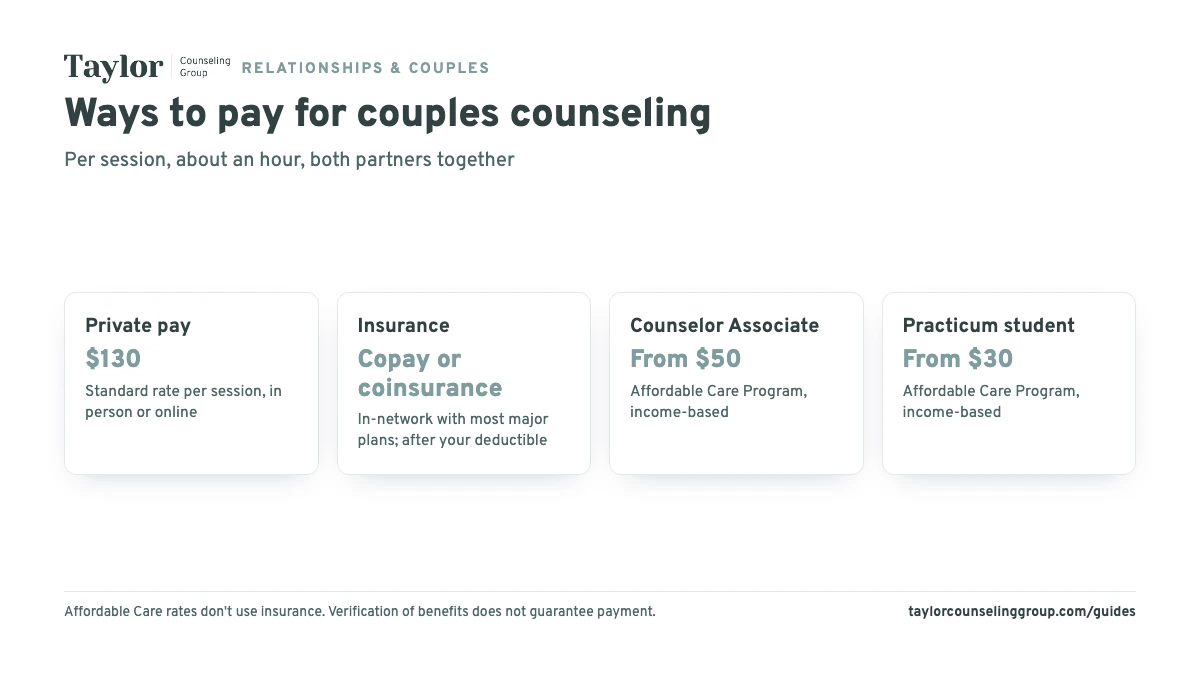
- Private pay: $130 per session, about an hour, both partners together.
- Insurance: we're in-network with most major plans; you'd usually owe a copay or coinsurance after your deductible.
- Affordable Care Program: income-based, from $50 with a Counselor Associate or $30 with a practicum student, no insurance used.
- Online sessions never cost extra, and we take credit cards plus FSA, HSA and HRA cards.
For couples in Texas who want to work on their relationship and need a clear picture of the price before they reach out.
What will couples counseling cost us per session and in total?
Private pay for couples counseling with our therapists is $130 per session, and a session lasts about an hour with both of you in the room. If we’re in-network with your plan, you’d typically pay a copay or coinsurance once your deductible is met, and our income-based Affordable Care Program starts as low as $50 a session with a Counselor Associate or $30 with a practicum student. Your total depends on how many sessions you need and how often you come.
Wherever you land on budget, there’s a way to start. Our couples counseling therapists use EFT, CBT and the Gottman Method, along with other approaches, to help you communicate and strengthen your relationship, in person or online. Our blog covers Whether Insurance Covers Couples Counseling, and the rest of our Relationships & Couples guides answer the next questions couples usually ask.
What does one couples counseling session cost?
Our standard private rate is $130 per session. That’s the price of the session itself, and a couples session is typically held with both of you present, so you aren’t paying twice because there are two of you on the couch. Most sessions run about an hour.
What moves your real cost up or down is whether you use insurance, whether you qualify for an income-based rate, how often you come and how many sessions you end up needing.
If money is the thing that’s been stopping you, you’re in good company. Lots of couples know their relationship needs attention and still put off calling because they’re worried about the price. Affordable care is one of our core values, so please don’t let a dollar sign be the reason you wait.
Does online couples counseling cost less, or more?
Neither. There’s never an additional cost to see your counselor by telehealth, so an online session is priced the same as one in our office. Sessions take place on a secure, HIPAA-compliant video platform, so you can talk from home on a night that works for both of you.
Online sessions can still save you money in quieter ways. You skip the drive, the parking and sometimes the babysitter, and it’s easier to find an hour you can both make when nobody has to cross town at rush hour. If you’re choosing between formats, think about where the two of you talk most openly. Some couples feel calmer at home; others find a neutral office helps them stay out of old habits.
What will we pay if we use our insurance?
We’re in-network with most major insurance plans. When we accept your plan, your out-of-pocket cost is typically a copay or coinsurance once your deductible has been met. The exact amount depends on your plan, which is why we can’t give you one number here. Our insurance contracts also don’t allow us to post our contracted rates.
A quick refresher on the words you’ll hear: a deductible is what you pay for covered care before your plan starts to pay, a copay is a set amount per visit, and coinsurance is a percentage of the cost you pay after the deductible. HealthCare.gov’s glossary has plain definitions of each if you want to dig in.
So if you haven’t met your deductible this year, you may pay the full amount your plan allows for each session until you do. Later in the year, the same session can cost you far less. Plans also differ on how they treat relationship-focused counseling, so it’s worth asking specifically about couples sessions. Our support staff will happily verify your benefits when you register, and you can see how payment works on our Insurance & Payment page. For the coverage question itself, our blog walks through Whether Insurance Covers Couples and Marriage Counseling.
One thing to know up front: verification of benefits doesn’t guarantee payment, and the client is responsible for the full cost of sessions. Checking early just means fewer surprises later.
What should we ask our insurance company before the first session?
A five-minute call to the number on the back of your card can save you a lot of guessing. Have a pen ready and ask:
- Do I have outpatient mental health benefits, and do they include couples or marriage counseling?
- How much of my deductible is left this year?
- After the deductible, do I pay a copay or coinsurance for an outpatient counseling visit?
- Do I need a referral or prior approval first?
- Do I have out-of-network benefits, and how do I get reimbursed?
- Is a telehealth session covered the same way as an in-office one?
Write down the date, the name of the person you spoke with and what they said. Then send your details to support@taylorcounselinggroup.com and our team will check your benefits for you too. Some of our providers may still be credentialing with a given insurer and may not be able to accept your plan yet, so when you’re matched, confirm that your therapist can take it.
What if the couples counselor we want is out of network?
Sometimes the therapist who feels like the right fit isn’t in network with your plan. That doesn’t have to end the conversation. If the counselor you’re working with isn’t in network with your insurance, we’ll work with you to file as an Out of Network Provider (OON). All plans are billed at our Usual and Customary Rate (UCR).
How much comes back to you depends on your plan’s out-of-network benefits, so ask your insurer what they reimburse and whether you need to meet a separate out-of-network deductible first. If the answer is “not much,” you still have options: you can ask to be matched with an in-network therapist, pay the private rate, or look at our Affordable Care Program below.
Get matched with a therapist
Easily schedule your appointment online at one of our locations in Central Texas.
Can we get a lower, income-based rate?
Yes, if you qualify. Our Affordable Care Program has income-based rates, so the price fits your household instead of the other way around:
- Counselor Associates: sessions as low as $50 per hour session.
- Practicum students: sessions as low as $30 per hour session.
Counselor Associates are Licensed Professional Counselor Associates, licensed by the Texas State Board of Examiners of Professional Counselors to practice under the supervision of a Licensed Professional Counselor Supervisor. Practicum students are finishing their master’s-level education. In the program, you’ll meet with an associate or practicum student under a Board Approved Professional Supervisor, so there’s an experienced clinician behind every case.
Eligibility is based on your income and household occupancy. To see if you qualify, ask for the Affordable Care Assistance Request form when you register.
The program doesn’t use insurance, and you don’t need to be in-network. In Texas, LPC Associates can’t accept insurance for payment, but they can work for reduced rates, which is exactly what the program is built around. If you have a high deductible you won’t meet this year, it’s worth comparing your expected insurance cost with the Affordable Care rate.
How many couples sessions should we budget for?
There isn’t a set number. Treatment can range from just a couple of sessions to years, depending on your goals and needs. Problems won’t be fixed in the first session; it takes time and commitment from both partners to see a difference.
What shapes the number:
- What you’re working on. Learning to argue more fairly about chores is different from rebuilding trust after an affair.
- How long it’s been going on. Patterns that have had years to settle in usually take longer to shift.
- How much you practice between sessions. The skills you try at home on a Tuesday night matter as much as the hour in the room.
- Whether you’re both in it. Counseling moves faster when both of you show up ready to work, even if one of you is nervous.
For engaged couples, premarital counseling is more structured, and many couples complete it in about 6 to 12 sessions. Our guide to What Premarital Counseling Is and What Happens in It covers that in detail.
The best way to budget is to ask your therapist after the first couple of sessions. Once they understand your goals, you can talk together about a rough plan and a point where you’ll check how it’s going. You stay in charge of the pace.
Weekly or every other week: how does frequency change the monthly cost?
Frequency doesn’t change the price of a session, but it changes what you spend in a month. At the private rate, weekly sessions come to about $520 in a four-session month, and every other week comes to about $260.
Many couples start weekly while things feel tense, then space sessions out once they’re using new skills on their own. Others start every other week because of cost or schedules and find that gives them time to practice in between. Either can work. What matters is a rhythm you can keep, because stopping and starting tends to cost more in the long run than a steady pace you can afford.
If you’re not sure, tell your therapist what your budget and calendar look like. That’s a normal part of planning, and they can suggest a schedule that fits what you’re working on.

Can we pay with an HSA or FSA card?
We accept all major credit cards, along with FSA and HSA cards and HRA accounts. Whether your account will pay for couples counseling is set by your plan’s rules, so check with your plan administrator before you count on it.
If you can use one, a health savings or flexible spending account lets you pay with money you’ve already set aside for care. It’s worth a quick look, especially for engaged couples budgeting around a wedding or families who’ve already planned this year’s medical spending.
What if only one of us is ready to come?
That happens a lot, and it doesn’t mean you’re stuck. It’s natural for one partner to be hesitant. Talking openly about their worries, and explaining that counseling is a space where both voices are heard, can help ease that reluctance.
If your partner still isn’t ready, you can start with individual counseling. You can work on how you show up in the relationship, how you handle conflict and what you need, and bring your partner in later if they decide to join. The same ways to pay apply: insurance, private pay or the Affordable Care Program. If worry about the relationship keeps looping in your head, our guide on How to Stop Overthinking in a Relationship has things you can try in the meantime.
How can we get the most out of every session we pay for?
You can’t control how long change takes, but you can make each hour count. A few habits help:
- Talk before you go. Agree on one or two things you most want to work on, even if you see them differently.
- Bring the real example. “We fought about my mom’s visit on Sunday” gives your counselor more to work with than “we don’t communicate.”
- Do the in-between work. If your therapist suggests a conversation exercise, try it, even clumsily.
- Protect the time. Pick a session time when you’re both reasonably rested, not squeezed between a late meeting and school pickup.
- Say what’s not working. If the fit feels off after the first few sessions, tell us. Our team will help you move to another provider in the group who fits better.
Wondering whether it’s worth the effort at all? Our guide on Whether Couples Counseling Works covers what helps it succeed and when a different first step makes sense.
Match with a therapist
Easily schedule your appointment online at one of our locations in Central Texas.
If you're engaged: a Texas premarital course can lower your license fee
Engaged couples in Texas have one extra money detail worth knowing. Under the state’s Twogether in Texas program, finishing an approved 8-hour premarital education course takes up to $60 off your marriage license fee and waives the 72-hour waiting period. The certificate is good for one year, and the course has to come from a registered Twogether in Texas provider, so ask any provider whether they’re registered before you sign up.
A course like that teaches communication and conflict skills to a set curriculum. Premarital counseling is time with a therapist focused on the two of you, and many couples do both.
A made-up example: budgeting for eight sessions
Here’s an illustration with made-up numbers, just to show how the pieces fit. Say a couple plans for 8 sessions to start, then checks in with their therapist about what’s next.
- Private pay: 8 sessions at $130 is $1,040.
- Affordable Care with a Counselor Associate, if they qualify at the lowest rate: 8 sessions at $50 is $400.
- Affordable Care with a practicum student, if they qualify at the lowest rate: 8 sessions at $30 is $240.
- Insurance: depends on their deductible and copay or coinsurance, which our support staff can check before the first session.
Spread over about two months of weekly sessions, or four months every other week, the total stays the same; only the monthly amount changes. Your own number will depend on your plan, your income and how many sessions you need.
Frequently asked questions
Why can't you tell us our insurance price up front?
Our insurance contracts don’t allow us to post contracted rates, and your cost depends on your own deductible, copay or coinsurance. Our support staff can verify your benefits when you register.
Can we use insurance and the Affordable Care Program together?
No. The Affordable Care Program doesn’t use insurance; it’s an income-based, out-of-pocket option. You choose whichever works better for your situation.
Do we need a diagnosis to start couples counseling?
No, you don’t need a formal diagnosis to begin therapy. Your therapist will start by getting to know you both and what you want to work on.
Who can we ask about billing questions?
Our support staff is available 8am–8pm Monday to Friday and 9am–3pm on Saturdays. You can call (214) 530-0021 or email support@taylorcounselinggroup.com.
How do we get started?
You can register and schedule through our online portal 24/7, or use Get Matched and we’ll help pair you with a couples counselor who fits what you’re looking for. You can also find a location near you.
Do you offer court-required couples counseling?
No. We don’t offer any court-based or court-required counseling services.
Key takeaways
- Our private rate is $130 per session, about an hour, with both partners together.
- With insurance you’d typically pay a copay or coinsurance after your deductible; verifying benefits early avoids surprises.
- The income-based Affordable Care Program starts as low as $50 with a Counselor Associate or $30 with a practicum student.
- Online sessions cost the same as in-office sessions.
- Your total depends on how many sessions you need and how often you come; plan it with your therapist.
Don't let your budget stand in the way
We are in-network with most major insurance plans and are happy to check your benefits for you. Ask about our income-based Affordable Care Program.
More in this section
Sources
- Deductible – Glossary — HealthCare.gov
- Copayment – Glossary — HealthCare.gov
- Coinsurance – Glossary — HealthCare.gov
- Mental health and substance abuse health coverage options — HealthCare.gov
- Frequently Asked Questions – Twogether in Texas — Texas Health and Human Services, Twogether in Texas

Dr. Christopher Taylor
Christopher S. Taylor, Ph.D., is the founder of Taylor Counseling Group, an existential psychotherapist and the author of You Are Here. A Board-Approved LPC Supervisor, he was appointed by Governor Greg Abbott to the Texas State Board of Examiners of Professional Counselors, where he was later elected Vice Chair.
This guide is general information from Taylor Counseling Group. It is not medical advice, a diagnosis or a substitute for care from a licensed mental health professional, and reading it does not create a counseling relationship. If you are in danger or need help right away, call 911 or go to the nearest emergency room.