
How do I cope with losing a parent?


- How do I cope with losing a parent as an adult?
- What can grief feel like after a parent dies?
- Why does losing a parent hit so hard, even as an adult?
- What can you do in the first few weeks?
- How do you take care of yourself while you grieve?
- How do you deal with guilt, regret and the “what ifs”?
- How do you get through birthdays, holidays and Mother’s or Father’s Day?
- How can you grieve alongside siblings and a surviving parent?
- How do you help your kids when their grandparent dies?
- How do you know if your grief needs more support?
- How can grief counseling help after a parent dies?
- What does grief counseling cost, and does insurance help?
- Getting grief support in Texas
- A made-up example: one person’s first few months
- Frequently asked questions
- Key takeaways
- More in this section
- Sources
The short version
- Mixed feelings like sadness, guilt, anger and even relief are all a normal part of losing a parent.
- Say yes to help, keep small routines, and hold off on big decisions while the loss sinks in.
- Plan ahead for birthdays, holidays and anniversaries, and line up extra support for those days.
- If grief isn’t easing or makes daily life hard, a grief counselor can help you work through it.
For adults in Texas whose mom or dad has died, recently or a while ago, and who want to know what helps and when to reach out for more support.
How do I cope with losing a parent as an adult?
Coping with losing a parent starts with letting yourself grieve in your own way, leaning on people you trust, and keeping a few simple routines while the loss sinks in. Plan ahead for birthdays, holidays and anniversaries, and give guilt, regret and relief room to be talked about. If the pain stays just as intense over time or makes it hard to get through your days, a grief counselor can help you work through it.
When you’re ready for support, our grief and loss counseling therapists meet with you in person at our Texas locations or online, at your pace, to help you carry the loss of your parent. Start with the Get Matched form and choose the option about working through a loss. For more questions like this one, browse our Grief & Loss guides.
What can grief feel like after a parent dies?
Losing a parent can knock your whole world off balance. One minute you’re numb, the next you’re crying in the cereal aisle because you spotted the brand your dad always bought. Feelings change from moment to moment, and they often contradict each other. That’s not you doing grief wrong. That’s what grief does.
Here’s what many people notice:
- Sadness and longing that comes in waves, sometimes out of nowhere.
- Feeling like a kid again, or unsure of your place in the family now.
- Guilt, regret or anger, especially if the relationship was strained.
- Relief, particularly if you cared for a parent through a long illness. Relief and love can sit side by side.
- Fear about your own mortality, which can feel surprising and heavy.
- Your body joining in. The National Institute on Aging lists trouble sleeping, little interest in food, problems concentrating and a hard time making decisions as common in grief.
All of these feelings are natural. You might even laugh at a funny memory and then feel guilty for it. That’s normal too.
Why does losing a parent hit so hard, even as an adult?
People expect it to be easier when you’re grown, or when a parent lived a long life. It rarely is. Your parent may have known you longer than anyone, and still saw you as their kid no matter how old you got.
A parent’s death can also shift who you are. You might become the oldest generation in your family overnight. You might take on jobs your parent used to handle, from hosting holidays to looking after a surviving parent. Losing your second parent can feel especially jolting, even if you saw it coming.
It’s also a loss most adults face sooner or later. U.S. Census Bureau data, reported in a 2024 Monitor on Psychology article, show that 44% of Americans have lost at least one parent by age 49, and nearly 76% have by age 59. Common doesn’t mean small, though. Friends who’ve been through it can help you feel less alone, but your grief still runs on its own timeline.
What can you do in the first few weeks?
The early days are often a blur of calls, paperwork and people. Then the casseroles stop coming, and the quiet sets in. A few things help with both:
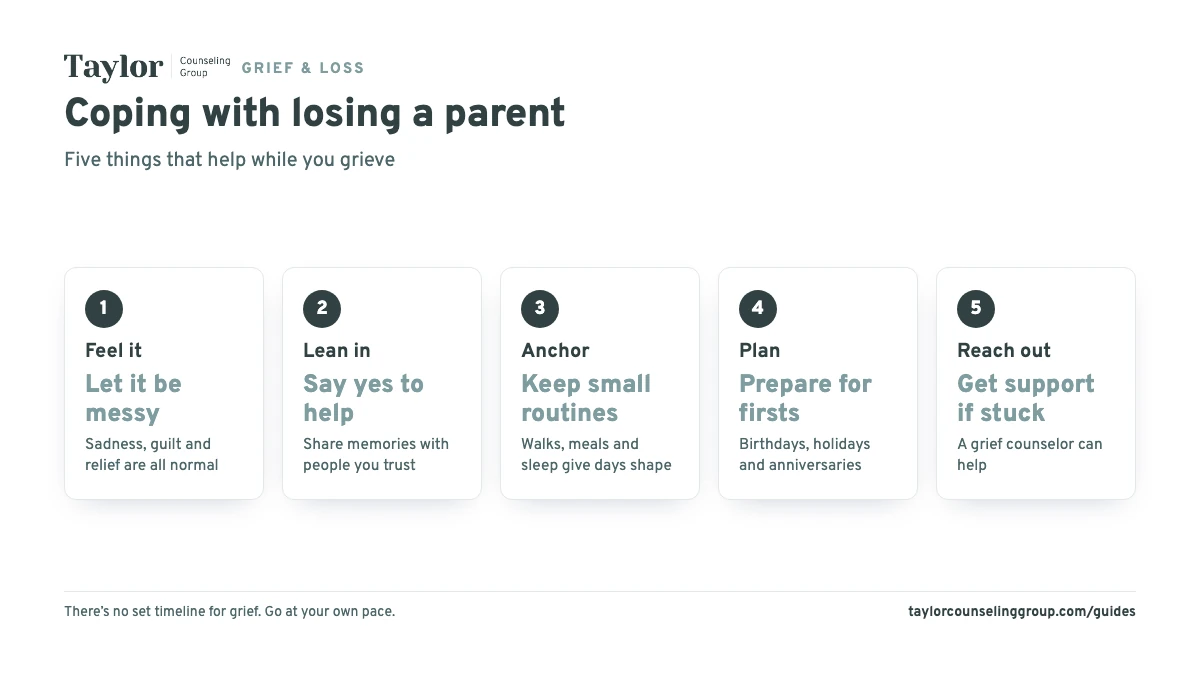
- Say yes to help. When someone asks what they can do, give them a real job: pick up groceries, return calls, sit with you while you sort mail.
- Keep a few anchors. A morning walk, a set bedtime, coffee at the same time each day. Small routines give a shaky week some shape.
- Eat something, even if it’s simple. Grief can wipe out your appetite. Eating with a friend or putting music on during meals can make it feel less lonely.
- Hold off on big decisions where you can. Selling a house or changing jobs can usually wait until your head is clearer.
- Let it be messy. Some days you’ll get a lot done. Some days, getting dressed is the win. Both count.
How do you take care of yourself while you grieve?
Grief takes a lot out of you. Taking care of yourself isn’t selfish. It’s what keeps you going.
- Lean on others. Sharing your feelings and memories with family and friends is a big part of grieving. Tell people when you want to talk about your mom or dad. Many folks hold back because they’re afraid of upsetting you.
- Let yourself feel. Every emotion you’re having is okay, even the ones that don’t make sense. Feelings you push down tend to wait for you.
- Keep up your routine when you can. Walk, see friends, pick up a hobby again. When you can’t, don’t be hard on yourself.
- Give your feelings somewhere to go. Journaling, music, drawing or talking it out with someone you trust can help you put words to what you’re carrying.
- Look after the basics. Move your body, try to get enough sleep, and keep an eye on drinking, which can quietly creep up when you’re hurting.
If you’re noticing grief spilling into your sleep, work and patience, our guide on How to Tell if Stress Is Affecting Your Daily Life has more ways to spot it and ease the load.
How do you deal with guilt, regret and the “what ifs”?
Almost everyone who loses a parent replays something. The call you didn’t return. The thing you said in an argument years ago. The treatment decision you signed off on near the end. Those “what if” loops tend to stop right at the moment you think you failed, and they skip everything else you did.
A few things can loosen their grip:
- Widen the frame. Next to the moment you regret, write down the ways you showed up: the appointments you drove to, the hard conversations, the times you advocated for them.
- Write a letter to your parent. Say what you wish you’d said, or what you’d say now. Set it aside and read it again later, or bring it to someone you trust.
- Separate hindsight from what you knew then. You made choices with the information and energy you had at the time.
- If you were estranged, you may grieve the parent you had, the parent you wished for, and the repair that won’t happen now. That’s grief too, and you don’t owe anyone a tidier version of the story.
If guilt keeps circling for weeks and starts crowding out everything else, that’s a good thing to bring to a counselor.
Get matched with a therapist
Easily schedule your appointment online at one of our locations in Central Texas.
How do you get through birthdays, holidays and Mother’s or Father’s Day?
Firsts are hard. The first birthday without them, the first Thanksgiving, the first Mother’s Day or Father’s Day, the anniversary of the day they died.
A plan helps:
- Decide how you want to spend it. Keep a tradition, change it, or skip it this year. Any of those can be the right call.
- Line up extra support. Plan a get-together with family, or ask a friend to check in that day.
- Make something to remember them by. A memory box, a photo album or a family get-together can turn a hard day into a day of connection.
- Do something they loved. Cook their famous recipe, watch their favorite team, visit their favorite spot.
If the season itself starts to feel heavy, our guide on Why Do I Feel Down During the Holidays? covers grief at the holidays and what helps.
How can you grieve alongside siblings and a surviving parent?
A parent’s death can pull a family closer, or stir up old sibling stuff when decisions about belongings and care land on top of everyone’s grief. Part of the friction is that people grieve differently. One sibling wants to talk about Mom every day; another dives into work. Neither is wrong.
- Name the difference out loud. “I need to talk about her. I know you need space. Can we find a middle ground?”
- Slow down on belongings. When you feel ready, sort things into keep, give away and not sure. Nothing has to be decided in one weekend.
- Share the load with a surviving parent. If your other parent is still living, they may need extra help, and you may be grieving while caring for them.
- Expect some surprises. A surviving parent may eventually start a new relationship. That can bring up a lot, and it’s okay to have mixed feelings.
If you were the main caregiver, your role and purpose may have shifted overnight. Even with relief in the mix, you can still feel lost.
How do you help your kids when their grandparent dies?
If you have children, they’re grieving too, and they’re watching how you grieve. You don’t need to hide your tears. Seeing you sad and taking care of yourself teaches them big feelings are okay.
- Use clear, simple words. “Grandma died” is easier for kids to understand than “we lost her” or “she went to sleep.”
- Keep their routines steady as much as you can. Familiar days help kids feel safe.
- Remember together. Drawing pictures, looking at photos or telling stories about their grandparent gives kids a way to hold on.
Kids grieve in bursts. They might cry, then run off to play five minutes later. If you’re wondering whether your child’s reactions are part of grieving or a sign they need more help, see How Do I Know if My Grieving Child Needs Therapy?.

How do you know if your grief needs more support?
There’s no set schedule for grieving a parent, and missing them years from now is part of loving them. For most people, the sharpest pain softens over time, with good days and bad days mixed in. Whether your grief needs extra support depends on how it’s going for you, not on how long it’s been.
These are the factors worth paying attention to:
- Is it easing at all? Grief that comes in waves but slowly loosens is different from pain that stays just as intense, or keeps growing.
- Can you function? Notice whether you’re able to work, look after yourself and the people who count on you, and keep up with friends.
- Do you feel stuck? Some people feel unable to accept the death, avoid every reminder, or feel life has lost all meaning.
- Is something else in the mix? A sudden death, past depression or little support can make grief heavier.
For a small group of people, intense grief lasts and gets in the way of daily life. The American Psychiatric Association calls this prolonged grief disorder and estimates it affects 4% to 15% of bereaved adults. You don’t need to be sure before reaching out. If low mood has settled in alongside the grief, our guide on How Counseling Can Help With Depression explains what that support looks like.
How can grief counseling help after a parent dies?
You don’t have to be falling apart to see a grief counselor. Talking with a trained grief counselor can help you unravel the complicated parts of losing a parent in a supportive, constructive way.
In grief counseling, you and your therapist might:
- Make space for anger, relief, guilt and unfinished business
- Plan ahead for anniversaries, holidays and other hard days
- Practice coping tools for the waves, like breathing, grounding and journaling
- Figure out how to honor your parent while you keep living your own life
Our therapists use evidence-based techniques to help ease some of the pain and fear that come with a loss. You set the goals together, and you go at your own pace. You don’t need a formal diagnosis to start. For more on what happens in sessions, read our blog post Grief Counseling: How Therapy Can Help You Heal After a Loss, or see how grief can move through The 7 Stages of Grief.
What does grief counseling cost, and does insurance help?
Cost shouldn’t be the thing that keeps you from support. You have three ways to pay with us:
- Insurance. We’re in-network with most major insurance plans. With a plan we accept, your out-of-pocket cost is typically a copay or co-insurance once your deductible is met. Our support staff will check your benefits before your first session. A benefits check isn’t a promise of payment, so you’re responsible for the full cost of sessions if your plan doesn’t pay. See insurance and payment for details.
- Private pay. Our standard private rate is $130 per session.
- Affordable Care Program. Our income-based program offers sessions with Counselor Associates from $50 per hour session and with Practicum Students from $30 per hour session, all under a Board Approved Professional Supervisor. This program doesn’t use insurance.
Most sessions last about an hour, and there’s never an extra cost to meet by telehealth.
Find a location near you
We provide affordable, reliable, and accessible care across Central Texas. Find a location near you.
Getting grief support in Texas
We have ten locations in Texas, and we also see clients online on a secure, HIPAA-compliant video platform, with phone sessions available too. That helps when you’re juggling a surviving parent’s care or just can’t face a drive on a hard day. When you fill out the Get Matched form, you can mark that you’re grieving a loss so we can match you with a therapist who fits. You can also find a location near you.
A made-up example: one person’s first few months
This is an illustration, not a real person. Dana is 41. Her dad died in the spring after a long illness, and she was his main caregiver. Once the funeral is over, she feels relief that he isn’t suffering, guilt about that relief, and lost without the daily appointments.
Dana starts small. She says yes when a friend offers to bring dinner on Sundays. She keeps her morning walk. She writes her dad a letter about the hospital decision she keeps replaying. As Father’s Day gets close, she plans a cookout with his favorite recipe and asks her brother to come.
By late summer, the waves are still strong, her sleep is off and work is slipping. Looking at the factors above, she decides she’d like more support and starts grief counseling online, around her job.
Frequently asked questions
Is it normal to feel relieved after my parent died?
Yes. Relief is common, especially after a long illness or a hard caregiving stretch. It can sit right next to deep sadness and love, and it doesn’t mean you cared any less.
Why does grief hit me out of nowhere months later?
Grief often comes in waves. A song, a smell or a phone call you’d normally make to your parent can bring it rushing back, even on a good day. Those sudden waves are a normal part of grieving.
Can I do grief counseling online?
Yes. We offer online sessions on a secure, HIPAA-compliant video platform, and phone sessions are available too. There’s no extra cost to meet by telehealth.
Do I need a diagnosis to start grief counseling?
No. A formal diagnosis isn’t needed to begin therapy. Many people start simply because the loss is big and they want support.
Will I ever stop missing my mom or dad?
Missing them may never fully go away, and that’s okay. For most people the sharpest pain softens over time, and the missing becomes something you carry alongside a full life.
Key takeaways
- Grief after losing a parent can bring sadness, guilt, anger, relief and fear about your own mortality, often all at once.
- Say yes to help, keep a few small routines, and give yourself permission to have messy days.
- Plan ahead for birthdays, holidays and anniversaries, and line up extra support for them.
- Family members often grieve differently; naming that out loud can ease friction with siblings.
- If grief isn’t easing or makes daily life hard, grief counseling can help, and no diagnosis is needed to start.
Getting the help you need shouldn't be complicated
So we make scheduling an appointment easy with our online booking tool.
More in this section
Sources
- Coping With Grief and Loss — National Institute on Aging
- Grieving the midlife loss of a parent — American Psychological Association, Monitor on Psychology
- Prolonged Grief Disorder — American Psychiatric Association
- Prolonged Grief Disorder: Course, Diagnosis, Assessment, and Treatment — Focus (American Psychiatric Publishing), via PubMed Central

Dr. Christopher Taylor
Christopher S. Taylor, Ph.D., is the founder of Taylor Counseling Group, an existential psychotherapist and the author of You Are Here. A Board-Approved LPC Supervisor, he was appointed by Governor Greg Abbott to the Texas State Board of Examiners of Professional Counselors, where he was later elected Vice Chair.
This guide is general information from Taylor Counseling Group. It is not medical advice, a diagnosis or a substitute for care from a licensed mental health professional, and reading it does not create a counseling relationship. If you are in danger or need help right away, call 911 or go to the nearest emergency room.