
What is the Gottman Method for couples?

- What is Gottman Method couples therapy, in plain terms?
- Where did the Gottman Method come from?
- What is the Sound Relationship House?
- What are the Four Horsemen, and what do we do instead?
- How does the Gottman Method handle conflict?
- What happens in Gottman Method couples therapy sessions?
- Is there research showing the Gottman Method works?
- How is the Gottman Method different from EFT and CBT?
- Is the Gottman Method a good fit for us?
- Can the Gottman Method help after an affair?
- How many Gottman Method sessions will we need?
- What Gottman-style habits can we try at home this week?
- Starting couples counseling in Texas
- A made-up example: turning the same old fight around
- Frequently asked questions
- Key takeaways
- More in this section
- Sources
The short version
- A research-based approach to couples therapy built on the Sound Relationship House: friendship, conflict and shared meaning.
- It teaches you to spot the Four Horsemen (criticism, contempt, defensiveness, stonewalling) and swap in better habits.
- Therapy usually begins with an assessment, then moves to practicing skills in sessions and at home.
- It works for married, engaged, dating and same-sex couples, and it sits alongside approaches like EFT and CBT.
For couples in Texas, married, engaged or dating, who’ve heard about the Gottman Method and want to know what it is and whether it fits them.
What is Gottman Method couples therapy, in plain terms?
The Gottman Method is a structured approach to couples therapy, developed by John and Julie Gottman from decades of research watching real couples talk and argue. It helps partners build friendship and fondness, manage conflict without criticism, contempt, defensiveness or stonewalling, and create shared meaning together. Sessions usually start with an assessment of your relationship, then move to practicing specific skills in the room and at home. It’s one of several approaches couples counselors use, alongside methods like EFT and CBT.
Curious whether the Gottman Method is right for the two of you? Our couples counseling therapists use EFT, CBT and the Gottman Method, along with other approaches, in person or online, and they’ll build a plan around your goals. Browse the rest of our Relationships & Couples guides for the next questions couples usually ask.
Where did the Gottman Method come from?
Most couples therapies started from a theory. The Gottman Method started from watching couples. Psychologist John Gottman and his colleagues spent years in a research lab recording couples as they talked about their day and argued about real disagreements, then followed those couples for years to see who stayed together and who didn’t. In one early study, Gottman and Robert Levenson followed 73 married couples and found that couples headed for trouble showed more negative emotion, less positive emotion, more stubbornness and withdrawal, and greater defensiveness.
John Gottman and his wife, psychologist Julie Schwartz Gottman, turned those patterns into a therapy: if we know what lasting couples do differently, we can teach those habits. That’s why the method feels so practical. You’re learning specific moves that make a relationship feel safer and warmer.
What is the Sound Relationship House?
The Sound Relationship House is the map at the center of the method and the research base it’s built on. It has seven levels, grouped into three systems: friendship, conflict and meaning. In everyday terms:
- Love maps: knowing your partner’s world, from this week’s worries to their hopes for the year.
- Fondness and admiration: noticing what you appreciate about each other, and saying it.
- Turning toward: responding when your partner reaches for connection, even in small ways.
- The positive perspective: giving each other the benefit of the doubt.
- Managing conflict: handling disagreements gently and repairing quickly.
- Making life dreams come true: supporting what each of you really wants out of life.
- Creating shared meaning: building your own rituals, values and sense of “us.”
Two walls hold the house up: trust and commitment. Your counselor uses the house to see which floors feel solid for you and which need work.
What are the Four Horsemen, and what do we do instead?
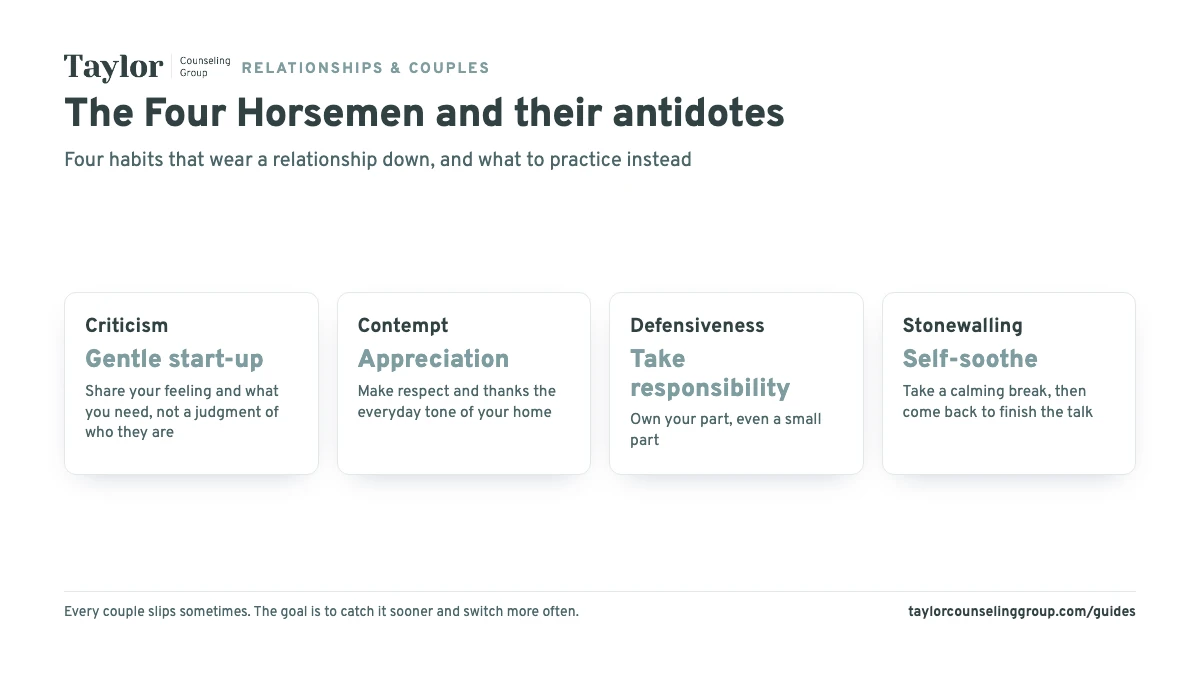
The Four Horsemen are the Gottman name for four ways of fighting that wear a relationship down over time. Each one has an “antidote,” a habit you can practice in its place:
- Criticism attacks your partner’s character (“You never think about anyone but yourself”). Instead: a gentle start-up. Talk about your feeling and what you need: “I felt alone at dinner tonight. Can we put our phones away tomorrow?”
- Contempt is criticism with a sneer: eye-rolling, mocking, sarcasm, name-calling. It’s the most damaging of the four. Instead: build a habit of appreciation, so respect is the everyday tone of your home.
- Defensiveness is the counterattack or the excuse (“Well, you’re late all the time too”). Instead: take responsibility for your part, even a small part: “You’re right, I forgot to call.”
- Stonewalling is shutting down: going silent, staring at your phone, walking away mid-sentence. It often happens when someone feels flooded, meaning their body is so stressed they can’t think straight. Instead: call a time-out, do something calming on your own, and come back to finish the talk.
Every couple uses the horsemen sometimes. Nobody is expecting perfect fights. The goal is to catch them sooner and switch to the antidote more often.
How does the Gottman Method handle conflict?
One of the most freeing ideas in the method is that not every problem needs solving. Gottman divides conflict into two kinds:
- Solvable problems are situational: who does school pickup, how to split the holidays. With a gentle start-up and some give on both sides, you can find a workable answer.
- Perpetual problems come from lasting differences in personality or values, like a saver married to a spender. Most couples have several. The goal is to talk about them with humor and kindness instead of getting stuck.
When a perpetual problem turns into gridlock, the same painful fight on repeat, your counselor helps you look underneath it. Often there’s a dream or deeply held value on each side. Once you each understand the dream behind the position, a compromise gets much easier.
You’ll also practice repair attempts: anything that stops a fight from spiraling. “Can we start over?” or a silly face can work. Repair doesn’t need to be graceful. It needs to be noticed and accepted.
What happens in Gottman Method couples therapy sessions?
Couples sessions are typically held with both of you present. Your first session is about getting to know you both and giving you space to talk, and you don’t need a formal diagnosis to begin. From there, Gottman Method therapy usually follows a clear arc:
- Assessment. Your counselor learns your history as a couple, often meets with each of you individually, and may ask you to fill out questionnaires.
- Feedback and a plan. Your counselor shares your strengths and growth areas, and you agree on goals together.
- Practice in the room. You may talk through a real disagreement in session while your counselor coaches you: slowing things down, pointing out a horseman, helping you try the antidote.
- Practice at home. Small exercises between sessions, like love map questions or a daily check-in.
- Tapering off. As new habits stick, sessions get spaced further apart.
Your therapist works with you on a personalized treatment plan built around your goals, so the exact path depends on the two of you.
Get matched with a therapist
Easily schedule your appointment online at one of our locations in Central Texas.
Is there research showing the Gottman Method works?
The method grew out of research on what makes relationships last, and studies have also tested the therapy itself. In one small trial, a 2018 study of 16 couples at a counseling center in Tehran randomly assigned half to 10 sessions of Gottman couple therapy and half to a waitlist. The couples who had therapy improved in marital adjustment and intimacy, and those gains held at follow-up.
Those are encouraging findings, but they come from small samples, so it’s fair to read them as a good sign rather than a final word. Couple therapy as a whole has a much larger body of research behind it, and our guide on Whether Couples Counseling Works walks through what helps it succeed.
Whatever the approach, problems won’t be fixed in the first session; it takes time and commitment from both of you.
How is the Gottman Method different from EFT and CBT?
Our couples counselors use EFT, CBT and the Gottman Method, along with other approaches. They overlap, and many counselors blend tools from more than one:
- The Gottman Method is skills-focused and structured: a map, named patterns and specific habits you practice at home.
- Emotionally Focused Therapy (EFT) looks at the emotional cycle underneath your fights, like one partner feeling shut out while the other feels criticized, and helps you reach for each other in a new way.
- Cognitive behavioral therapy (CBT) works on the thoughts and habits that drive conflict, like assuming the worst about your partner’s motives, and builds problem-solving skills.
You don’t have to choose a method before you start. Tell us what you’re hoping for, maybe “we want concrete tools” or “we need to understand why we keep hurting each other,” and we’ll match you with a counselor whose way of working fits. If the fit doesn’t feel right, our team will help you move to another provider in the group.
Is the Gottman Method a good fit for us?
It depends on what you want from counseling and how you like to work. The Gottman Method tends to suit couples who:
- like structure, clear explanations and a sense of where the sessions are headed;
- want practical tools and don’t mind homework;
- feel more like roommates than partners;
- keep having the same fight and want a new way to handle it.
It isn’t only for married couples. The Gottmans’ 2017 summary of their work describes the love that draws people into a lasting, committed relationship regardless of sexual orientation, and our couples counseling is inclusive of same-sex partners. Dating, engaged, married, living together: if the relationship matters to you, it’s for you. Engaged couples can also look at our guide on What Premarital Counseling Is and What Happens in It, and families coming together can read about Blended Families and When Counseling Helps.
If there’s current abuse, coercive control or fear of retaliation in the relationship, couples counseling may not be the right first step, and individual support is the safer place to start. Otherwise, a couples counselor can help you sort out whether the method fits.
Can the Gottman Method help after an affair?
Yes, it has a specific path for rebuilding trust, usually described in three phases:
- Atone. The partner who broke trust takes responsibility, answers questions openly and stays present for their partner’s pain without getting defensive.
- Attune. You work on what was missing and learn to listen and respond in new ways, without shifting the blame.
- Attach. You rebuild physical and emotional closeness at a pace that feels safe for both of you.
A 2024 pilot trial, which included the Gottmans among its authors, randomly assigned 49 couples dealing with infidelity to Gottman Method therapy or to the therapy they’d usually get; 19 couples completed all the before-and-after measures. Overall, the Gottman group did better, especially on trust, conflict management, relationship satisfaction and quality of sex. Healing after an affair is slow, careful work with no set timeline.
How many Gottman Method sessions will we need?
There isn’t a set number. Treatment can range from just a couple of sessions to years, depending on your goals and needs.
Most sessions last about an hour. Many couples start weekly while things are tense, then space sessions out once they’re catching the horsemen on their own. After your first few sessions, ask your counselor what a rough plan looks like and when you’ll check in on progress.
If budget is part of the decision, our guide on How Much Couples Counseling Costs in Texas walks through private pay, insurance and income-based rates. And if worry about the relationship is keeping you up at night while you decide, our guide on How to Stop Overthinking in a Relationship has ideas you can try today.
What Gottman-style habits can we try at home this week?
You don’t need to be in therapy to try a few of these:
- Ask one love map question a day. “What’s stressing you out at work right now?”
- Say one specific appreciation. “I loved how patient you were with the kids at bedtime.”
- Turn toward small bids. A bid is any small reach for connection: “Look at that sunset,” a sigh after work, a meme at lunch. Look up from your phone and respond.
- Soften your start-up. Try “I feel… about… and I need…” instead of “You always…”
- Agree on a time-out signal. When either of you feels flooded, take a real break, then come back to finish the talk.
If every attempt turns into the same fight, that’s a good sign it’s time to bring in a counselor who can coach you through it in real time.
Get matched with a therapist
Easily schedule your appointment online at one of our locations in Central Texas.
Starting couples counseling in Texas
We have ten locations in Texas plus online sessions on a secure, HIPAA-compliant video platform, at no extra cost. Our standard private rate is $130 per session, and we’re in-network with most major insurance plans (see our Insurance & Payment page). If cost is what’s holding you back, our income-based Affordable Care Program offers sessions with Counselor Associates from $50 and Practicum Students from $30, under a Board Approved Professional Supervisor. When you get matched, tell us you’re interested in the Gottman Method, or that you’re not sure which approach fits, and we’ll take it from there.
A made-up example: turning the same old fight around
Here’s an illustration with a made-up couple. Priya and Marcus fight about money every few weeks. Priya opens with “You’re so irresponsible,” Marcus fires back with a list of her spending, then goes silent for the night.
- Assessment: their counselor notices criticism and defensiveness from both, and stonewalling from Marcus once he feels flooded. She also sees strengths: they laugh easily and know each other’s worlds.
- Practice: Priya tries a gentle start-up: “I get anxious when the credit card bill comes. Can we look at it together on Sunday?” Marcus owns his part and asks for a break before he shuts down.
- Going deeper: money turns out to be a perpetual problem. Priya needs to feel secure; Marcus wants to enjoy life now. They agree on a savings goal plus a small fun fund for each.
The money talk still comes up, but it’s calmer and shorter. Nothing changed overnight; they practiced again and again.
Frequently asked questions
Can we do Gottman Method couples therapy online?
Yes. Online sessions take place on a secure, HIPAA-compliant video platform, and there’s no additional cost to see your counselor by telehealth. In-session practice conversations work well on video too.
Is the Gottman Method religious?
No, it’s a research-based approach that couples of any faith or none can use. If faith matters to you, we also offer faith-based counseling, and you can mention it when you get matched.
Can one partner start the Gottman Method alone?
Couples sessions are typically held with both partners present. If your partner isn’t ready, you can start with individual counseling to work on how you show up in the relationship, and bring your partner in later.
Will insurance cover Gottman Method couples therapy?
Benefits for couples counseling vary by plan. Our support staff can check your benefits before your first session, though verifying benefits doesn’t guarantee payment. Our Insurance & Payment page has the details.
Do we have to do homework?
Usually, yes, but it’s small: a daily check-in, a few love map questions, or trying a gentle start-up during the week. Practice between sessions is where much of the change happens.
Key takeaways
- The Gottman Method is a structured couples therapy built from years of research on how lasting couples talk and argue.
- Its map, the Sound Relationship House, covers three systems: friendship, conflict and shared meaning.
- You learn to spot the Four Horsemen (criticism, contempt, defensiveness, stonewalling) and practice an antidote for each.
- Sessions usually start with an assessment, then move to coached practice in the room and small exercises at home.
- Our couples counselors use EFT, CBT and the Gottman Method, along with other approaches, matched to your goals.
You deserve affordable, reliable, & accessible care
We accept most major insurances and are dedicated to providing high-quality services at affordable rates. Our support staff is available to answer any questions you may have.
More in this section
- How much does couples counseling cost in Texas?
- Does couples counseling work?
- What is premarital counseling and what happens in it?
Sources
- Marital processes predictive of later dissolution: behavior, physiology, and health — Journal of Personality and Social Psychology (PubMed)
- Sound Relationship House in Gottman Method Couples Therapy — Encyclopedia of Couple and Family Therapy (Springer Nature)
- Examining the Effectiveness of Gottman Couple Therapy on Improving Marital Adjustment and Couples' Intimacy — Iranian Journal of Psychiatry (PubMed Central)
- A Pilot Study Examining the Effectiveness of Gottman Method Couples Therapy Over Treatment-as-Usual Approaches for Treating Couples Dealing with Infidelity — The Family Journal (SAGE)
- The Natural Principles of Love — Journal of Family Theory & Review (Wiley)

Dr. Christopher Taylor
Christopher S. Taylor, Ph.D., is the founder of Taylor Counseling Group, an existential psychotherapist and the author of You Are Here. A Board-Approved LPC Supervisor, he was appointed by Governor Greg Abbott to the Texas State Board of Examiners of Professional Counselors, where he was later elected Vice Chair.
This guide is general information from Taylor Counseling Group. It is not medical advice, a diagnosis or a substitute for care from a licensed mental health professional, and reading it does not create a counseling relationship. If you are in danger or need help right away, call 911 or go to the nearest emergency room.