
How do I boost self-esteem?


- How do you boost self-esteem when the voice in your head won't let up?
- Why does low self-esteem feel so hard to shake?
- How do you talk back to your inner critic?
- Why do small promises to yourself matter so much?
- How do boundaries and saying no build self-esteem?
- How do you stop comparing yourself to everyone else?
- What does self-compassion look like on a hard day?
- How are low self-esteem and depression connected?
- What gets in the way when you try to feel better about yourself?
- How can you help a child or teen with low self-esteem?
- When is it time to talk to a counselor about self-esteem?
- How does counseling help you build self-esteem?
- How do you get started, and what does it cost?
- What's different when you look for self-esteem counseling in Texas
- A made-up example: two weeks of small steps
- Frequently asked questions
- Key takeaways
- More in this section
- Sources
The short version
- Notice your inner critic and answer it with fairer, real-life evidence.
- Make tiny promises to yourself and keep them so you build proof you can rely on.
- Practice boundaries and saying no, and spend more time with people who lift you up.
- Talk to a counselor if the critic keeps winning or low mood comes with it.
For anyone in Texas who’s tired of feeling “not good enough” and wants real, everyday steps, plus a sense of when talking to a counselor would help.
How do you boost self-esteem when the voice in your head won't let up?
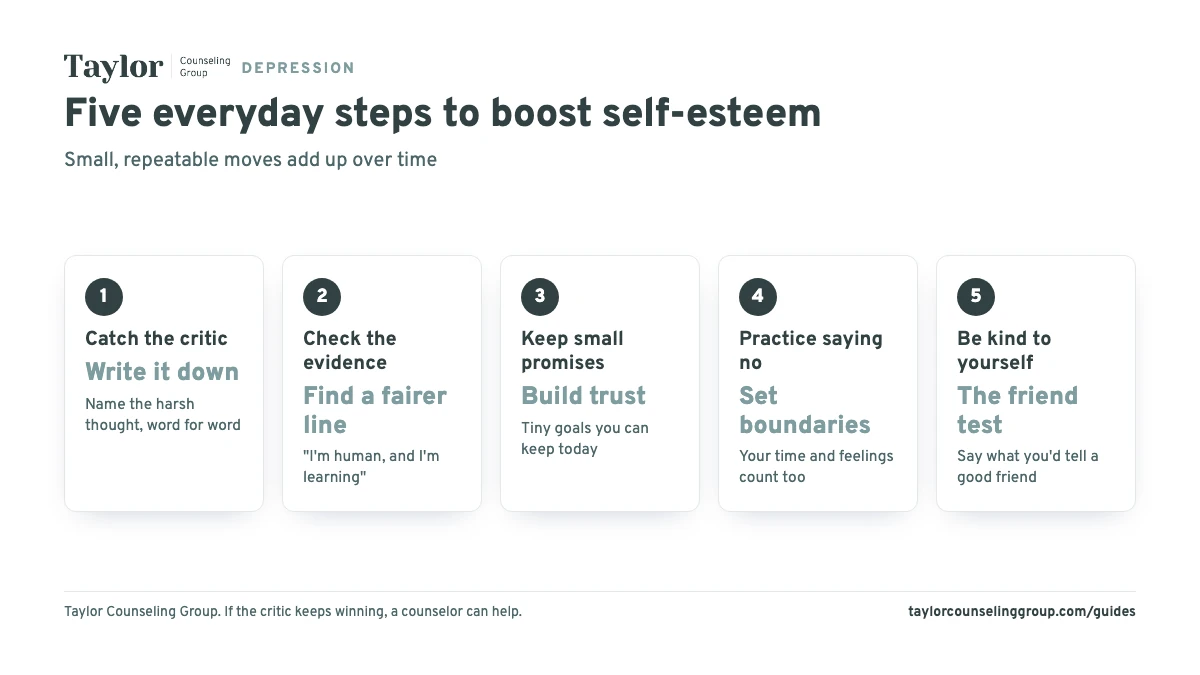
You boost self-esteem by changing how you talk to yourself and what you do each day, not by waiting to feel confident first. Catch your inner critic and answer it with fairer evidence, make small promises to yourself and keep them, practice saying no, and treat yourself the way you’d treat a good friend. Low self-esteem usually builds over years, so it shifts with steady practice, and a counselor can help when the old “not good enough” story keeps winning or comes with feeling down.
Low self-esteem and low mood often travel together, and you don’t have to untangle them on your own. Our depression counseling therapists work with you in person at our Texas locations or online, and our self-esteem counseling focuses on the thoughts and habits that keep you stuck. For more on why self-worth matters in the first place, read our post Why Is Self-Esteem & Body Image Important?, and browse the rest of our Depression guides for the next questions people ask.
Why does low self-esteem feel so hard to shake?
Self-esteem is simply the opinion you hold of yourself. When it’s low, you tend to see yourself and your life through a harsh, critical lens, and the challenges in front of you feel bigger than you are.
That opinion usually didn’t form overnight. Messages from parents, teachers, siblings, friends and the media add up, and for some reason the “you’re not good enough” message is the one that sticks. Stressful seasons like a breakup, a layoff, an illness or a loss can knock it down further.
Low self-esteem also keeps itself going, because it makes you avoid things. You skip the party, don’t apply for the job, stay quiet in the meeting. Avoiding feels safer in the moment, but it quietly teaches you that you can’t cope, so the doubt grows. Building self-esteem means gently breaking that loop, and you can do it at any age.
How do you talk back to your inner critic?
Your inner critic is the voice that says “you always mess things up” or “nobody really likes you.” It sounds like the truth, but it isn’t. It’s a habit of thinking, and habits can change.
Try this for a week or two:
- Catch it. When you notice a harsh thought, jot it down in your phone or a notebook, word for word.
- Name the pattern. Is it all-or-nothing (“I failed”)? Mind reading (“they think I’m boring”)? A label (“I’m such a loser”)?
- Look for evidence. What actually happened? What would someone who knows you well say? Write down at least one fact that doesn’t fit the critic’s story.
- Write a fairer line. Not a fake-positive one. Swap “I’m such a loser” for “Hey, I’m human, and I’m learning.”
Keep a running list of things you like about yourself and kind things people have said. On a rough day, it’s proof you can hold in your hand.
If the critic gets especially loud in your love life, our guide on how to Stop Overthinking in a Relationship walks through that version of the spiral.
Why do small promises to yourself matter so much?
Think about how you learn to trust someone. They say they’ll do something, and they do it. Again and again. Self-esteem works the same way. Every time you keep a promise to yourself, you add a little evidence that you’re someone you can count on.
The trick is making the promises small enough to keep, especially when your energy is low:
- Drink a glass of water when you wake up.
- Take a ten-minute walk after lunch.
- Go to bed at the time you picked.
Small wins beat big resolutions. A promise to “get my whole life together” sets you up to feel like a failure by Wednesday. A promise to make your bed is one you can keep today. Once a small promise feels easy, stretch it a little.
Looking after your body counts, too. Sleep, movement and regular meals set your mind up to cope, and they’re easy places to start keeping your word to yourself.
How do boundaries and saying no build self-esteem?
If you have low self-esteem, you might feel like you have to say yes to everyone. Yes to the extra project, yes to the favor, yes to plans you dread. People-pleasing usually comes from a deep need for approval or a fear of conflict, and over time it leaves you worn out and resentful.
Every respectful “no” tells you something important: your time and feelings count too. Most of the time, saying no doesn’t damage a relationship at all.
A few ways to practice:
- Start low-stakes. Turn down something small, like a sales call or an optional meeting, before you tackle a family member.
- Buy time. “Let me check and get back to you” gives you room to decide what you actually want.
- Keep it short. “I can’t this time, but thanks for thinking of me.” You don’t owe a long explanation.
Being assertive isn’t being harsh. It’s respecting other people’s needs and expecting the same respect back. Notice, too, who leaves you feeling smaller. Where you can, spend less time with them and more time with people who appreciate you.
How do you stop comparing yourself to everyone else?
Comparison feeds low self-esteem. You put your messy behind-the-scenes life next to someone else’s best moments, and of course you come up short.
Some things that help:
- Compare with your past self. Are you a little steadier, braver or kinder than you were last year? That’s the comparison that means something.
- Curate your feed. Mute or unfollow accounts that leave you feeling worse. You’re allowed to protect your attention.
When comparison shows up at work as a nagging sense that you’ll be “found out,” it can look a lot like imposter syndrome. That feeling often comes with burnout, which our guide on How to Recover from Burnout covers.
Get matched with a therapist
Easily schedule your appointment online at one of our locations in Central Texas.
What does self-compassion look like on a hard day?
Self-compassion means being gentle with yourself when you’d normally reach for criticism. It isn’t letting yourself off the hook. It’s how you’d treat a friend who’s struggling: honest, but kind.
Try the friend test. Picture a close friend who just made the same mistake you did. What would you say to them? Most of us give far better advice to others than we give ourselves. Now say that to you.
On a hard day, that might sound like:
- “This is really hard right now, and it makes sense that I’m upset.”
- “What do I need right now? Rest? A walk? A call with someone?”
A 2023 meta-analysis of 56 randomized trials found that self-compassion programs had small to medium effects on depressive symptoms, anxiety and stress right after the program, though the authors rated the overall risk of bias across the trials as high.
How are low self-esteem and depression connected?
They’re closely linked, and each can feed the other. When you feel worthless, you pull back from people and the things you enjoy, which can deepen low mood. And when you’re depressed, it’s easy to read every setback as proof that something is wrong with you.
Researchers have looked at which comes first. A meta-analysis of 77 longitudinal studies on depression, with people ranging from childhood to old age, found that low self-esteem predicted later depression more strongly than depression predicted later self-esteem. The authors suggested that if future research confirms that link, helping people raise their self-esteem might lower their risk of depression.
That’s why working on self-esteem is often part of counseling for depression. If you’ve been feeling flat, heavy or unmotivated as well as “not good enough,” our guide on How Counseling Can Help with Depression explains what that support looks like. And if your self-worth takes a dip every December, read Why You Feel Down During the Holidays.
What gets in the way when you try to feel better about yourself?
Plenty of people try hard to boost their self-esteem and feel like nothing sticks. Usually one of these is in the way:
- Affirmations you don’t believe. Saying “I’m amazing” in the mirror can backfire when part of you is shouting “no, you’re not.” Fair, believable lines work better: “I’m doing my best with what I have today.”
- Waiting to feel confident first. Confidence tends to follow action, not the other way around. Do the small brave thing while you’re still nervous.
- Only working on the outside. A new haircut or a promotion feels good, but if the inner critic hasn’t changed, it finds something new to pick at.

How can you help a child or teen with low self-esteem?
Kids and teens pick up a lot from the people around them, so parents have real influence here. A few things help:
- Praise effort, not just results. “You kept going even when that was hard” builds more than “You’re so smart.”
- Let them try, struggle and solve. Stepping in too fast can send the message that you don’t think they can handle it.
- Watch your own self-talk. If they hear you call yourself stupid or criticize your body, they learn that’s how people talk to themselves.
If your child seems stuck in harsh self-criticism, has pulled away from friends or seems down for weeks, it’s worth talking to a counselor. For younger children, our guide Is Play Therapy Right for My Child? explains how kids work through big feelings through play. Our therapists also work with teens who are struggling with low mood.
When is it time to talk to a counselor about self-esteem?
You don’t have to wait until things are falling apart. Counseling can help if:
- The inner critic runs most of your day, and the steps above don’t seem to touch it.
- You avoid opportunities, friendships or dating because you’re sure you’ll fail or be rejected.
- You say yes to everyone and feel resentful or exhausted.
- You’ve been feeling down, flat or hopeless along with “not good enough.”
- Low self-esteem seems tied to something painful from your past.
You don’t need a formal diagnosis to start therapy. “I don’t feel good about myself and I want that to change” is a perfectly good reason to reach out.
How does counseling help you build self-esteem?
Counseling gives you a safe, nonjudgmental space to look at where your beliefs about yourself came from, then practice new ones in real life. Many of our therapists use cognitive behavioral therapy (CBT) for self-esteem. The “cognitive” part helps you spot the core beliefs and thought patterns that fuel low self-worth and weigh them against the evidence. The “behavioral” part is taking small, manageable steps toward what you’ve been avoiding, so you build a track record of success.
In a small 2012 randomized trial in a primary care setting, people who got 10 sessions of CBT aimed at low self-esteem did better than a waitlist group on self-esteem, overall functioning and depression, and they kept those gains at follow-up. The researchers called the findings preliminary because the group was small.
Your therapist works with you to build a personalized treatment plan around your goals. If your first therapist isn’t the right match, our team helps you move to another provider in the group.
How do you get started, and what does it cost?
You can get matched with a therapist online, fill out your intake forms at least 24 hours before your first session and meet in person or online. Sessions last about an hour.
- Insurance: we’re in-network with most major insurance plans, and our support staff will check your benefits. Verifying benefits doesn’t guarantee payment, so it’s worth asking what your plan covers. See our insurance and payment page.
- Paying privately: our standard private rate is $130 per session.
- Tighter budget: our income-based Affordable Care Program offers sessions with Counselor Associates from $50 and with Practicum Students from $30. These sessions don’t use insurance.
- Online: sessions run on a secure, HIPAA-compliant video platform, phone sessions are available, and there’s no extra cost for telehealth.
Find a location near you
We provide affordable, reliable, and accessible care across Central Texas. Find a location near you.
What's different when you look for self-esteem counseling in Texas
In Texas, counselors are licensed by the Texas State Board of Examiners of Professional Counselors. LPC Associates in Texas can’t accept insurance for payment but can work for reduced rates, which is how our Affordable Care Program keeps costs down. Those clients see Counselor Associates or Practicum Students under a Board Approved Professional Supervisor, and all of our providers are professionally trained and properly licensed.
We have ten locations in Texas, plus online counseling anywhere in the state. Find a location near you.
A made-up example: two weeks of small steps
This is an illustration, not a real person.
- The starting point: Jordan calls himself “useless” a dozen times a day, says yes to every extra task at work and hasn’t seen friends in a month.
- Days one to three: He writes down each harsh thought. Most show up after he checks email at night.
- Days four to seven: He picks one promise, a short walk after work, and keeps it five days out of seven. He writes one fairer line for each harsh thought: “I missed one deadline. I’ve hit plenty of others.”
- Week two: He tells his manager, “I can take that on next week, not this week.” Nothing bad happens. He texts a friend to grab tacos on Saturday.
- What’s next: The critic is still there, but quieter. Jordan decides to talk to a counselor about where the “useless” label started.
Your version will look different, with its own off days.
Frequently asked questions
How long does it take to build self-esteem?
It depends on you. Low self-esteem usually builds over years, so it shifts gradually. Many people notice small changes, like a quieter inner critic, once they practice new habits steadily.
Do positive affirmations actually work?
They help most when you believe them. If “I’m amazing” feels false, try a fair, specific line like “I handled that hard conversation” instead.
Is self-esteem the same as confidence?
They overlap but aren’t the same. Confidence is usually about a specific skill, like public speaking, while self-esteem is your overall sense of worth. You can feel confident at work and still feel “not good enough” as a person.
Can a relationship lower your self-esteem?
Yes. Constant criticism, comparison or feeling like you have to earn love can wear down how you see yourself. Counseling can help you sort out what’s yours to work on and what isn’t.
Can someone seem confident and still have low self-esteem?
Yes. Plenty of people look sure of themselves on the outside while their inner critic runs nonstop. How you feel about yourself matters more than how you come across.
Key takeaways
- Self-esteem grows through what you think and do each day, not by waiting to feel confident.
- Catch your inner critic, check the evidence and write a fairer, believable line.
- Keep small promises to yourself and practice saying no to build trust in yourself.
- Self-compassion means treating yourself like a good friend, honestly but kindly.
- Low self-esteem and depression are closely linked; counseling can help with both, in person or online.
Getting the help you need shouldn't be complicated
So we make scheduling an appointment easy with our online booking tool.
More in this section
Sources
- Raising low self-esteem — NHS
- Tips to improve your self-esteem — Mind
- Self-esteem: Take steps to feel better about yourself — Mayo Clinic
- Does low self-esteem predict depression and anxiety? A meta-analysis of longitudinal studies — PubMed
- Cognitive behaviour therapy for low self-esteem: a preliminary randomized controlled trial in a primary care setting — PubMed
- Effects of Self-Compassion Interventions on Reducing Depressive Symptoms, Anxiety, and Stress: A Meta-Analysis — PubMed Central

Dr. Christopher Taylor
Christopher S. Taylor, Ph.D., is the founder of Taylor Counseling Group, an existential psychotherapist and the author of You Are Here. A Board-Approved LPC Supervisor, he was appointed by Governor Greg Abbott to the Texas State Board of Examiners of Professional Counselors, where he was later elected Vice Chair.
This guide is general information from Taylor Counseling Group. It is not medical advice, a diagnosis or a substitute for care from a licensed mental health professional, and reading it does not create a counseling relationship. If you are in danger or need help right away, call 911 or go to the nearest emergency room.