
How can counseling help us stay united for our kids after divorce?


- How can counseling help us present a united front to our kids after a divorce?
- What does staying united actually mean after a divorce?
- How does counseling help co-parents work together?
- What do co-parents actually talk about in sessions?
- How do you keep the kids out of the middle?
- Should you go together, separately or as a family?
- What if your ex won’t come to counseling?
- How do you tell your kids about the divorce together?
- What signs show your kids are having a hard time?
- How do you handle different rules in two homes?
- Where does your own healing fit in?
- What happens when a new partner comes into the picture?
- How do you get started, and what does it cost?
- What’s different for families in Texas?
- A worked example: one made-up family learning to co-parent
- Frequently asked questions
- Key takeaways
- More in this section
- Sources
The short version
- Staying united means a shared parenting approach, not getting back together.
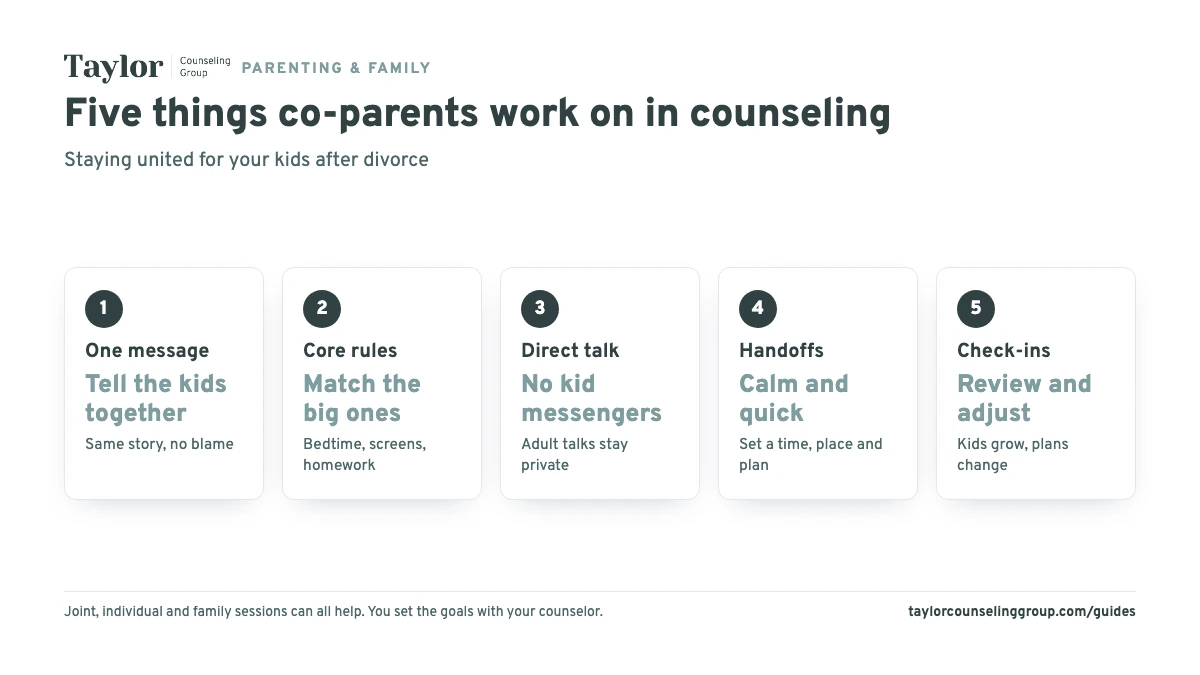
- Co-parenting sessions focus on communication, consistent rules, handoffs and how you talk to the kids.
- Joint, individual and family sessions can all fit; many families use a mix.
- If your ex won’t come, your own sessions can still change a lot.
For separated or divorced parents in Texas who want to keep parenting as a team, even when the marriage is over and the feelings are still raw.
How can counseling help us present a united front to our kids after a divorce?
Counseling gives co-parents a neutral place to agree on what you’ll tell the kids, keep core rules and routines steady across two homes, and work through disagreements without putting your children in the middle. Sessions can be the two of you together, each parent on your own, or the whole family, depending on how much tension there is and what your kids need. You don’t have to like each other again to make it work. You just have to keep showing up as parents on the same side.
Divorce changes the shape of a family, not the fact that you’re both still parents. Our family counseling helps parents and kids work through new routines, hard conversations and lingering conflict, at ten locations in Texas and online. If you’re healing from the split yourself, our divorce and relationship recovery counseling can help too. For more questions like this one, browse our Parenting & Family guides.
What does staying united actually mean after a divorce?
It doesn’t mean pretending nothing happened, and it definitely doesn’t mean getting back together. Staying united means you two agree on the big parenting stuff and back each other up in front of the kids, even when you disagree about plenty of other things.
In practice, a united front usually looks like:
- One message. Your kids hear the same story about the divorce from both of you.
- Shared core rules. Bedtimes, screens, homework and consequences line up closely across both homes.
- Respect out loud. Neither of you criticizes the other where the kids can hear.
- Direct communication. You talk to each other, not through your children.
That’s a tall order when you’re hurt, angry or exhausted. It’s also completely learnable, and it’s exactly the kind of work counseling is built for.
How does counseling help co-parents work together?
The biggest thing counseling offers is a neutral room. When you and your ex try to sort out a schedule change at the front door, old hurts tend to hijack the conversation. With a counselor in the room, the focus stays on your kids.
Here’s what a counselor does in co-parenting work:
- Sets the ground rules. One person talks at a time, no rehashing the marriage, and every topic comes back to what the kids need.
- Slows down the hot moments. When a conversation starts to spiral, the counselor helps you both pause, name what’s happening and get back on track.
- Teaches communication skills. Things like keeping messages short and factual, listening for the actual request and saying no without starting a fight.
- Helps you build a plan. Many co-parents leave with written agreements on rules, routines and how you’ll handle the stuff that keeps tripping you up.
Counseling won’t make every disagreement disappear, and it takes effort from both of you. It can make disagreements smaller, shorter and far less visible to your kids.
What do co-parents actually talk about in sessions?
Every family is different, but these topics come up again and again:
- Telling the kids. What you’ll say, who says it and how you’ll handle their questions.
- Rules across two homes. Which rules need to match and which can differ.
- Handoffs. Where, when and how to make exchanges calm and quick.
- How you’ll communicate. Text, email or a shared calendar, how fast you’ll reply, and what topics wait for a session.
- Holidays, birthdays and school events. Who goes where, and how to share the big days without the kids feeling torn.
- Discipline. How to support each other’s consequences instead of undoing them.
- New partners. When and how to introduce someone new, and how to talk about it with each other first.
You set the agenda with your counselor. Bring the one issue that causes the most fights, and start there.
How do you keep the kids out of the middle?
Kids love both of you, and they know parts of each of you go into making them. When they get pulled into adult conflict, it can feel like they have to pick a side. A few habits protect them:
- Don’t make them the messenger. “Tell your mom you need cleats by Saturday” puts them right in the middle. Send the message yourself.
- Keep adult talks private. Have hard conversations, calls and texts where your kids can’t see or hear them.
- Skip the digs. No eye-rolls, sighs or “your father always…” comments. Kids notice the small stuff too.
- Don’t ask them to spy or keep secrets. Questions about the other home should be about your child’s life, not your ex’s.
- Let them love the other parent freely. Your child should be able to look forward to time at the other house without feeling guilty.
- Don’t lean on them for comfort. Lines like “You’re the man of the house now” hand a child a grown-up job they can’t do.
Slip-ups happen. If your child overhears something hurtful, own it simply: “I was upset and said something unkind. That was about grown-up stuff, not you.”
Should you go together, separately or as a family?
There’s no single right setup. Many families use a mix over time:
- Joint co-parenting sessions. Just the two parents, focused on communication and plans. This is usually the core of staying united.
- Individual sessions. Each parent works on their own grief, anger or stress. This can make joint sessions go a lot smoother.
- Family sessions. Family therapy can include the whole family or a few willing members, like one parent and the kids, or both parents and the kids together. Treatment may be brief single sessions to sort out a specific issue or recurring sessions for more complex problems.
- Support for your child. Younger kids often work through big changes best in play therapy, while older kids and teens may prefer talking. Read The Difference Between Play Therapy and Talk Therapy for Kids to compare.
If there’s been abuse in the relationship, or you feel unsafe around your ex, joint sessions may not be the right first step. Individual support is the better place to start.
Get matched with a therapist
Easily schedule your appointment online at one of our locations in Central Texas.
What if your ex won’t come to counseling?
You can still go, and it can still help your kids. You can’t control your ex, but you can change how you respond, and that often lowers the temperature on both sides.
On your own, a counselor can help you:
- Write short, calm messages that don’t invite a fight
- Decide which battles matter for your kids and which to let go
- Handle your own anger or hurt so it doesn’t leak into handoffs
- Set clear, kind boundaries around communication
- Keep your home steady even when the other home runs differently
Sometimes the other parent joins later, once things feel calmer. Either way, the steady home you build matters to your kids.
How do you tell your kids about the divorce together?
If you can, tell them together. Hearing the same calm message from both parents is one of the first and strongest ways to show them you’re still a team. A counselor can help you plan and even rehearse the conversation.
- Keep it simple. Match the details to their age, and don’t share more than they’re asking for.
- Make it clear it’s not their fault. Also tell them they can’t fix it or bring you back together.
- Say what stays the same. You both love them, you’ll both always be their parents, and here’s what their week will look like.
- Leave out blame. The reasons for the split are grown-up business.
- Expect questions, now and later. “Will you get back together?” and “Where will I sleep?” are common. “We’re still figuring that out, and we’ll tell you as soon as we know” is a fine answer.
One conversation isn’t enough. Keep the door open, and check in again over the coming weeks.
What signs show your kids are having a hard time?
Some sadness, anger or worry is expected. Kids may even feel relief if things at home were tense. What you’re watching for is a pattern that lasts or keeps growing.
- Younger kids may become more clingy, aggressive or uncooperative, have tantrums, or pull back and seem withdrawn.
- Older kids may feel deep sadness and loss, and their schoolwork or behavior may slip.
- Teens may withdraw from family or friends, try to take charge of the family, or take more risks.
- At any age, kids may blame themselves, worry about loyalty to both of you, or keep hoping you’ll get back together.
The American Academy of Pediatrics, in a clinical report summarized on HealthyChildren.org, says many children experience short-term painful feelings and bounce back within 2 to 3 years after the separation, though divorce can be associated with longer-term problems. It also says children do better when parents collaborate, communicate regularly and keep consistent rules across homes. If your child’s distress seems stuck, see Is Play Therapy Right for My Child?

How do you handle different rules in two homes?
Your homes won’t be identical, and they don’t need to be. Kids can handle “Dad’s house has pancakes on Saturdays” just fine. What throws them is when the big things swing wildly from one house to the other.
A practical way to sort it out with your counselor:
- Agree on the must-match list. Usually bedtime ranges, screen limits, homework expectations, safety rules and how consequences work.
- Let the rest be different. Chores, meals and house traditions can vary. Tell the kids, “Different houses, different ways, and that’s okay.”
- Back each other’s consequences. If phone time was lost at one house, the other house doesn’t quietly hand it back.
- Keep routines steady. Regular meals, chores and bedtimes help kids know what to expect each day.
- Review it. Kids grow and schedules change. Revisit the list every so often.
Where does your own healing fit in?
Right at the center. It’s hard to stay calm at a handoff when you’re grieving the marriage, furious about how it ended or barely sleeping. Taking care of yourself isn’t selfish. It’s part of staying available for your kids.
Individual counseling gives you a private place to work through the loss, the anger and the fear about what comes next, without your kids or your ex in the room. If you’ve been feeling low for a while, read How Counseling Can Help with Depression. If you’re running on empty from juggling it all, How to Recover from Burnout has practical next steps.
As things settle, you may find it easier to see your ex as a co-parent rather than an opponent. That shift alone can change the tone of your kids’ whole week.
What happens when a new partner comes into the picture?
New relationships are often the moment a hard-won co-parenting peace gets tested. Kids may worry about loyalty, and the other parent may feel replaced.
- Give your co-parent a heads-up before introducing someone to the kids. Nobody wants to hear big news from a seven-year-old.
- Go slowly. Short, low-key time together first, with no pressure for the kids to warm up fast.
- Keep discipline with the parent, at least at first.
- Protect one-on-one time with your kids, so they don’t feel pushed aside.
If the new relationship turns into a combined household, read What Is a Blended Family, and When Counseling Helps for what to expect.
How do you get started, and what does it cost?
- Get matched. Fill out the Get Matched form and choose “For My Family” or “For My Child (under 18).” You can also find a location near you, or meet online on a secure, HIPAA-compliant video platform, which helps when you live in different parts of town.
- Complete the paperwork. Intake forms are completed online at least 24 hours before the first appointment. For a child, a parent completes a Consent for Treatment of a Minor form.
- Start with the first session. It’s mostly about getting to know you and what your family needs.
For payment, we’re in-network with most major insurance plans, and our support staff will check your benefits for you. A benefits check isn’t a promise of payment, and you’re responsible for the full cost of sessions if your plan doesn’t pay. Our standard private rate is $130 per session. Our Affordable Care Program is income-based, with Counselor Associates from $50 per hour session and Practicum Students from $30 per hour session, and it doesn’t use insurance. See insurance and payment for details.
Get matched with a therapist
Easily schedule your appointment online at one of our locations in Central Texas.
What’s different for families in Texas?
Texas requires custody documents or a current court order verifying authority to consent to a minor’s treatment. If you’re divorced or separated and your child will be in sessions, have those papers ready before the first visit. We serve clients from age five through late adulthood at ten locations in Texas, so the same practice can support each parent, the kids and the family together.
A worked example: one made-up family learning to co-parent
Here’s an illustration with a made-up family, not a real client. Jordan and Alex separated last spring. Their kids are 6 and 9. Handoffs in the driveway keep turning into arguments, the 9-year-old has started asking which parent is “right,” and the 6-year-old cries every Sunday night.
They start with joint co-parenting sessions focused on one goal: calmer handoffs. Together they agree to move exchanges to school pickup, keep logistics in a shared calendar, and save bigger topics for sessions. They also agree on a must-match list for bedtime and screens. Alex adds a few individual sessions to work through anger about the split. They also ask whether a child therapist could help the 6-year-old with Sunday nights. Nothing is fixed overnight, but the kids stop being in the room for the fights.
Frequently asked questions
Is co-parenting counseling the same as couples counseling?
No. Couples counseling works on the relationship itself. Co-parenting work focuses only on how you raise your kids together from two homes.
Do we have to be friends to co-parent well?
No. Many co-parents keep things polite and businesslike, and that works fine. The goal is cooperation on parenting, not closeness.
Should our kids come to the sessions?
Sometimes. Many families start with just the parents, then add family sessions when there’s something specific to work through together, like a new schedule or a hard conversation.
Can we do co-parenting sessions online from different homes?
Our online sessions take place on a secure, HIPAA-compliant video platform, and phone sessions are available too. There’s no additional cost to see a counselor by telehealth.
Is it too late if we’ve been divorced for years?
It’s never too late to make things calmer for your kids. Long-running patterns can take time to change, but even small shifts in how you talk can make a real difference at home.
Will the counselor take sides?
A co-parenting counselor’s focus is your kids, not deciding who’s right. If you ever feel the sessions are tilting, say so; our team will help you move to another provider in our group if the fit isn’t right.
Key takeaways
- Staying united means a shared parenting approach, not getting back together.
- Counseling gives co-parents a neutral place to agree on rules, handoffs and how you talk to the kids.
- Keep kids out of the middle: no messengers, no digs and adult talks in private.
- Joint, individual and family sessions can all help, and you can start even if your ex won’t come.
- Your own healing makes it easier to show up calmly for your kids.
You deserve affordable, reliable, & accessible care
We accept most major insurances and are dedicated to providing high-quality services at affordable rates. Our support staff is available to answer any questions you may have.
More in this section
- What is a blended family, and when counseling helps?
- What is the difference between play therapy and talk therapy for kids?
- Is play therapy right for my child?
Sources
- How to Support Children after Their Parents Separate or Divorce — HealthyChildren.org (American Academy of Pediatrics)
- Divorce and Separation: How to Help Your Child Adjust — HealthyChildren.org (American Academy of Pediatrics)
- Children and Divorce — American Academy of Child and Adolescent Psychiatry
- Treating Children's Mental Health with Therapy — Centers for Disease Control and Prevention

Dr. Christopher Taylor
Christopher S. Taylor, Ph.D., is the founder of Taylor Counseling Group, an existential psychotherapist and the author of You Are Here. A Board-Approved LPC Supervisor, he was appointed by Governor Greg Abbott to the Texas State Board of Examiners of Professional Counselors, where he was later elected Vice Chair.
This guide is general information from Taylor Counseling Group. It is not medical advice, a diagnosis or a substitute for care from a licensed mental health professional, and reading it does not create a counseling relationship. If you are in danger or need help right away, call 911 or go to the nearest emergency room.