
How do I know if my grieving child needs therapy?


- How do I know if my child’s grief is normal or needs a therapist?
- What does normal grief look like in kids?
- How do kids understand death at different ages?
- Which signs suggest a grieving child may need more help?
- How long is too long for a child to struggle after a loss?
- Which losses make extra support more likely to help?
- Should your child see their own therapist, or should you go as a family?
- How can play therapy help a grieving child?
- What about grieving teens?
- What can you do at home to help your child grieve?
- How do you look after your own grief while helping your child?
- How do you get started, and what does it cost?
- What’s different for families in Texas?
- A made-up example: one family deciding whether to get help
- Frequently asked questions
- Key takeaways
- More in this section
- Sources
The short version
- Crying then playing, clinginess, anger and acting younger are common in grieving kids.
- Reactions that last for weeks, keep growing, or disrupt sleep, school or friendships are a reason to reach out.
- Sudden or frightening deaths, and the death of a parent or sibling, make extra support more likely to help.
- Play therapy, individual counseling and family counseling can each fit, and a child therapist can help you choose.
For parents and caregivers in Texas whose child has lost someone close, and who want to know which reactions are part of grieving and when to get professional help.
How do I know if my child’s grief is normal or needs a therapist?
Most grieving children cry, act younger, get angry or swing between sadness and play, and those reactions are a normal part of grief. It’s worth talking to a professional when reactions last more than a few weeks, keep getting stronger, or get in the way of sleep, school, friends or daily life, or when the death was sudden or frightening. Whether your child needs their own therapist, play therapy or family counseling depends on their age, the loss and how the whole family is coping, and a child therapist can help you sort that out.
If you’re still unsure, a child therapist can help you sort out what your child needs. Our play therapy for children is built for kids about 5 to 12, and our grief and loss counseling supports teens, parents and whole families at our Texas locations and online. For more questions like this one, browse our Grief & Loss guides.
What does normal grief look like in kids?
Kids grieve differently from adults, and it can be confusing to watch. Your child might sob at bedtime and then ask for a snack like nothing happened. That switch doesn’t mean they’re over it or didn’t care. Play is often how kids take a break from feelings that are too big to hold all at once.
Common reactions in the weeks after a death include:
- Crying, then playing. Grief tends to come in short bursts for kids.
- Acting younger. Wanting extra cuddles, baby talk, clinginess, or even wetting the bed again.
- Anger. It may show up as rough play, irritability, nightmares, or snapping at the people still here.
- The same questions, over and over. Asking again is how kids make sense of something that doesn’t make sense.
- Worry about who’s next. After a death, many kids fear losing a parent or caregiver too.
- Not seeming upset at all. Some kids look fine at first. That’s okay too.
Sadness can also come back for a long time, especially around birthdays and holidays, and sometimes at moments you’d never predict. That’s grief doing its normal work, not a setback.
How do kids understand death at different ages?
What your child understands shapes how they grieve. The American Academy of Child and Adolescent Psychiatry explains that preschoolers usually see death as temporary and reversible, while children between five and nine start to think about death more like adults do, yet still believe it won’t happen to them or anyone they know.
- Little ones may keep asking when Grandpa is coming back. Clear, gentle repetition helps: “Grandpa died. His body stopped working, and he can’t come back.”
- Young kids often believe their thoughts make things happen. A child who once wished someone gone in a moment of anger may secretly blame themselves. Tell them plainly that nothing they thought, said or did caused the death.
- School-age kids usually understand that death is permanent, and they may ask detailed questions about what happened. Answer honestly and simply. “I don’t know” is a fine answer too.
- Teens understand death fully but may grieve privately, lean on friends more than family, or show it through irritability and pulling away.
Skip phrases like “went to sleep” or “we lost her.” Kids are literal, and soft words can create new fears, like being scared of bedtime.
Which signs suggest a grieving child may need more help?
One rough week isn’t a red flag. What matters is when reactions settle in and stay. Signs that a child may be having serious trouble with grief include:
- A long stretch of deep sadness where they lose interest in things they used to enjoy
- Trouble sleeping, loss of appetite, or a fear of being alone that won’t ease
- Acting much younger than their age for an extended time
- Copying the person who died in an extreme way
- Believing, for an extended time, that they’re talking to or seeing the person who died
- Pulling away from friends
- A sharp drop in schoolwork, or refusing to go to school
- Saying again and again that they want to join the person who died
If any of these keep going, it’s time to talk with a professional. That last one deserves a call to your child’s doctor or a child therapist right away rather than waiting to see if it passes.
How long is too long for a child to struggle after a loss?
There’s no exact cutoff, and kids revisit grief as they grow. Whether your child needs support depends on a few things together:
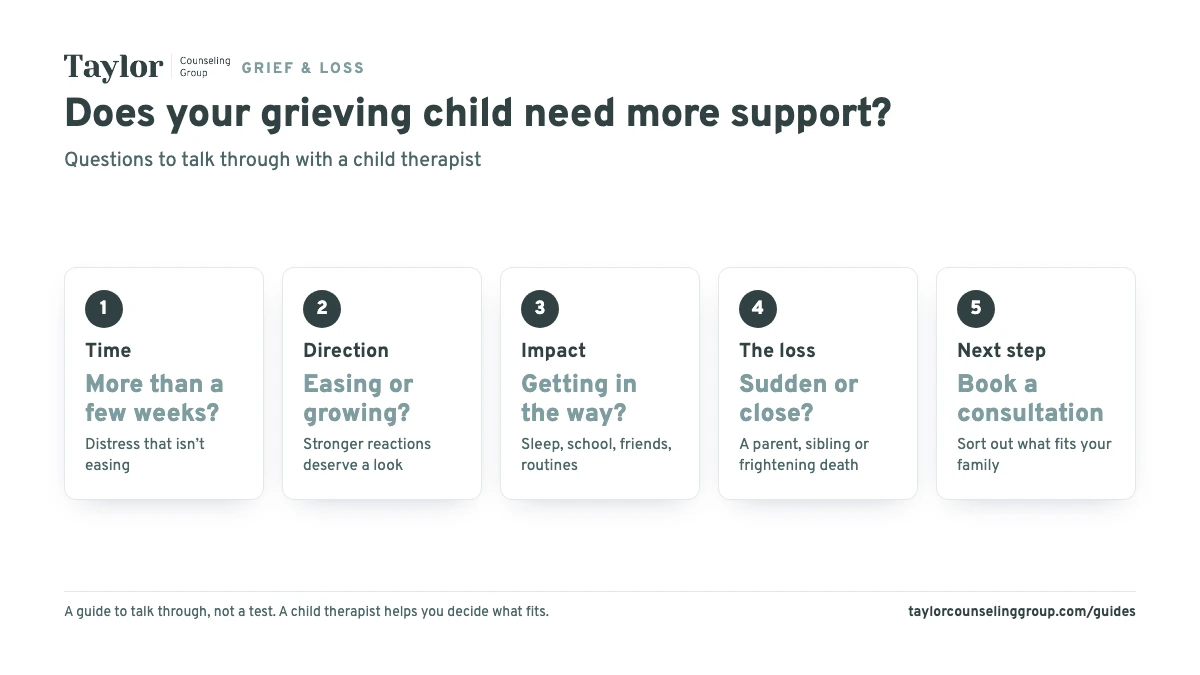
- Is it easing or growing? Big feelings right after a death are expected. Distress that stays just as strong, or keeps building, deserves a closer look.
- How long has it lasted? If your child’s distress lasts more than a few weeks, talk with their doctor, who can help you find the right therapist.
- Is it getting in the way? Notice sleep, eating, school, friendships and everyday routines. Trouble in more than one place is worth paying attention to.
- Does it fit your child? You know them best. If you keep thinking “this isn’t like them,” that counts.
You don’t have to be certain before you reach out. A consultation can end with “this is normal grief, and here’s how to support it at home,” and that’s a good outcome too.
Which losses make extra support more likely to help?
Some losses are simply harder for kids to carry. Support is worth considering sooner when:
- The death was sudden, violent or deeply frightening. A child may need therapy to heal from a loss like this.
- A parent or sibling died. These people are at the center of a child’s world, so the ripple effects reach almost everything.
- Daily life changed a lot, like a move or a new caregiver.
- The grown-ups are struggling too. When the adults around a child are deeply grieving, it’s harder for them to give the usual care and attention, through no fault of their own.
- Memories have become painful. The National Child Traumatic Stress Network describes childhood traumatic grief, when trauma reactions after a death interfere with everyday life and make it hard for a child to recall happy memories of the person. It can follow a sudden death or one that was expected.
When trauma is part of the picture, our trauma recovery therapists offer TF-CBT, CPT and EMDR, and a therapist can help you sort out which approach, if any, fits your child.
Get matched with a therapist
Easily schedule your appointment online at one of our locations in Central Texas.
Should your child see their own therapist, or should you go as a family?
It depends on where the grief is showing up and who’s carrying it. These are the factors a therapist weighs with you:
- Your child’s age and how they communicate. Younger kids often do best in play therapy, which is typically for ages 5 to 12. Older kids and teens who like to talk may do well in individual counseling.
- Whether it’s mostly your child or the whole household. If everyone is hurting and home feels tense, family counseling gives you a shared space to navigate grief, understand each other and feel more together. Family therapy can include the whole family or just a few willing members.
- How siblings are coping. Brothers and sisters often grieve in very different ways, and family sessions can help them understand each other.
- How you’re doing. Kids take their cues from the adults around them. Support for you can be support for them too.
These aren’t either-or choices. Many families pair a child’s play therapy with some family sessions. For a closer look at the playroom side, read Is Play Therapy Right for My Child?.
How can play therapy help a grieving child?
Most young children can’t sit down and explain how they feel about a death. They can show it, though. In play therapy, toys work like words and play works like sentences. A child might bury a toy figure in the sand tray, build a house where someone is missing, or play out a hospital scene again and again.
A trained play therapist notices those themes and gently helps your child:
- Name feelings like sadness, anger, fear and guilt
- Make sense of what happened in a way that fits their age
- Let go of mistaken beliefs, like thinking they caused the death
- Find ways to remember the person, through drawings, stories or a memory book
- Practice coping skills they can use at home and school
Play therapy can help children heal from the loss of a loved one and other big life changes. Children typically do play therapy for two to twelve months, depending on how complex the concerns are, and you stay involved with check-ins and ideas to try at home.
What about grieving teens?
Teens can be the hardest to read. Many hide grief from parents, to protect you or because friends feel safer. You might see moodiness, time alone, slipping grades, or a push to act like nothing happened.
A few things help:
- Keep the door open without forcing it. Car rides and late-night kitchen chats often work better than sit-down talks.
- Let them grieve their way. Music, writing, sports or time with friends can all be healthy outlets.
- Watch the bigger picture. Withdrawal from friends, refusing school or losing interest in everything for weeks is a reason to reach out.
We see clients from age five through late adulthood, so a teen can have their own counselor, with the option of family sessions alongside.

What can you do at home to help your child grieve?
You don’t need perfect words. You need to be there.
- Use simple, direct words. “I have some sad news. Grandma died today.” Then pause and let it sink in.
- Listen and comfort. Hugs, sitting together and answering questions matter more than any speech.
- Name feelings, yours included. “I’m sad too.”
- Give them a role. Picking a song, gathering photos or making a card can help a child feel part of a memorial. Never force a scared child to attend a funeral. Lighting a candle or planting something together can be a goodbye too.
- Keep routines steady. Familiar days help kids feel safe.
- Talk, then shift. After a few minutes of talking, move to something comforting, like drawing, cooking or a walk.
Keep saying the person’s name. Sharing happy memories helps kids learn that healing doesn’t mean forgetting.
How do you look after your own grief while helping your child?
If you’re helping a child through a death, you’re probably grieving too. It’s okay for your kids to see you cry. What helps them most is seeing you sad and also seeing you take care of yourself.
- Lean on relatives and friends to keep your child’s routines going when you need a break.
- Find your own place to talk, so you’re not carrying everything alone.
- Be gentle with yourself on low days. If grief is spilling into your sleep and patience, see How to Tell if Stress Is Affecting Your Daily Life.
If you’ve lost your own mom or dad, our guide on How Do I Cope With Losing a Parent? has ideas for you. If low mood has settled in and won’t lift, How Counseling Can Help With Depression explains what support looks like. Taking care of yourself is part of taking care of them.
How do you get started, and what does it cost?
- Get matched. Fill out the Get Matched form and choose “For My Child (under 18).” You can mark that your family is grieving a loss.
- Ask for a consultation if you’d like one. You can schedule a consultation for your child before scheduling an appointment, to talk through play therapy, family counseling or both.
- Complete the paperwork. Intake forms are completed online at least 24 hours before the first appointment, including a Consent for Treatment of a Minor form.
- Get to know each other. The first session is mostly about the therapist getting to know you and your child and giving you space to talk.
You have three ways to pay. We’re in-network with most major insurance plans, and our support staff will check your benefits. A benefits check isn’t a promise of payment, so you’re responsible for the full cost of sessions if your plan doesn’t pay; see insurance and payment. Our standard private rate is $130 per session. Our Affordable Care Program is income-based, with sessions from $50 per hour session with Counselor Associates and from $30 per hour session with Practicum Students, under a Board Approved Professional Supervisor, and it doesn’t use insurance.
Find a location near you
We provide affordable, reliable, and accessible care across Central Texas. Find a location near you.
What’s different for families in Texas?
Texas requires custody documents or a current court order that shows you can consent to your child’s treatment. If you’re a guardian, a grandparent raising a grandchild after a death, or a surviving parent whose paperwork is still being sorted, pull those papers together early. We have ten locations in Texas, plus online sessions on a secure, HIPAA-compliant video platform, so you can find a location near you or meet from home.
A made-up example: one family deciding whether to get help
This is an illustration, not a real family. Leo is 9. His grandma, who lived with the family and walked him to school every day, died suddenly in the fall. For the first few weeks he cried at night and asked the same questions over and over, which his parents expected.
Three months later, things are getting harder, not easier. He refuses to go to school most mornings, sleeps in his parents’ room, has stopped seeing friends, and gets angry whenever anyone mentions her. His mom is grieving too.
Looking at the factors above, the loss was sudden, the reactions have lasted months and are growing, and they show up at home, at school and with friends. Those factors point toward getting support. His parents fill out the Get Matched form, schedule a consultation, and talk through play therapy for Leo with a few family sessions alongside.
Frequently asked questions
Is it normal that my child doesn’t seem sad?
Yes. Some kids look fine at first, and many grieve in short bursts between play. Keep checking in and keep talking about the person, and watch how things go over the coming weeks.
Should my child go to the funeral?
It’s a family decision. If your child wants to go, explain ahead of time what they’ll see and hear. Never force a frightened child to attend; a candle, a drawing or a family memory can be their goodbye.
Will talking about the person who died make it worse?
Usually not. Kids often worry that bringing up the person will upset you. Saying their name and sharing happy memories shows your child that remembering is welcome.
Does my child need a diagnosis before starting therapy?
No. A formal diagnosis isn’t needed to begin therapy. Many families start because a loss is big and they want a professional view.
Do both parents need to agree to therapy?
A parent with authority to consent completes the Consent for Treatment of a Minor form, and Texas requires custody documents or a current court order showing that authority. Having both caregivers on board also helps keep things steady at home.
Key takeaways
- Crying then playing, clinginess, anger and acting younger are common parts of a child’s grief.
- Reach out when reactions last more than a few weeks, keep growing, or get in the way of sleep, school or friends.
- Sudden or frightening deaths, and losing a parent or sibling, make extra support more likely to help.
- Play therapy, individual counseling and family counseling can each fit, alone or together.
- Clear words, steady routines and shared memories at home help, and so does caring for your own grief.
Getting the help you need shouldn't be complicated
So we make scheduling an appointment easy with our online booking tool.
More in this section
Sources
- Grief and Children — American Academy of Child and Adolescent Psychiatry
- When a Loved One Dies: How to Help Your Child — Nemours KidsHealth
- Traumatic Grief and Separation — The National Child Traumatic Stress Network
- Children and Mental Health: Is This Just a Stage? — National Institute of Mental Health

Dr. Christopher Taylor
Christopher S. Taylor, Ph.D., is the founder of Taylor Counseling Group, an existential psychotherapist and the author of You Are Here. A Board-Approved LPC Supervisor, he was appointed by Governor Greg Abbott to the Texas State Board of Examiners of Professional Counselors, where he was later elected Vice Chair.
This guide is general information from Taylor Counseling Group. It is not medical advice, a diagnosis or a substitute for care from a licensed mental health professional, and reading it does not create a counseling relationship. If you are in danger or need help right away, call 911 or go to the nearest emergency room.