
What should I expect in my first therapy session?


- What actually happens in a first therapy session, start to finish?
- What happens before the first session even starts?
- How does the first session begin?
- What questions will my therapist ask me?
- Do I have to share everything in the first session?
- Will my therapist give me a diagnosis or a plan right away?
- What stays private in a therapy session?
- What if I cry, freeze or don't know what to say?
- Is a first online session any different?
- What's different about a first couples, family or child session?
- How will I know if my therapist is a good fit?
- What happens after the first session?
- What Texas rules mean for your first session
- A made-up example: one person's first hour
- Frequently asked questions
- Key takeaways
- More in this section
- Sources
The short version
- Fill in your intake forms online at least 24 hours before the appointment.
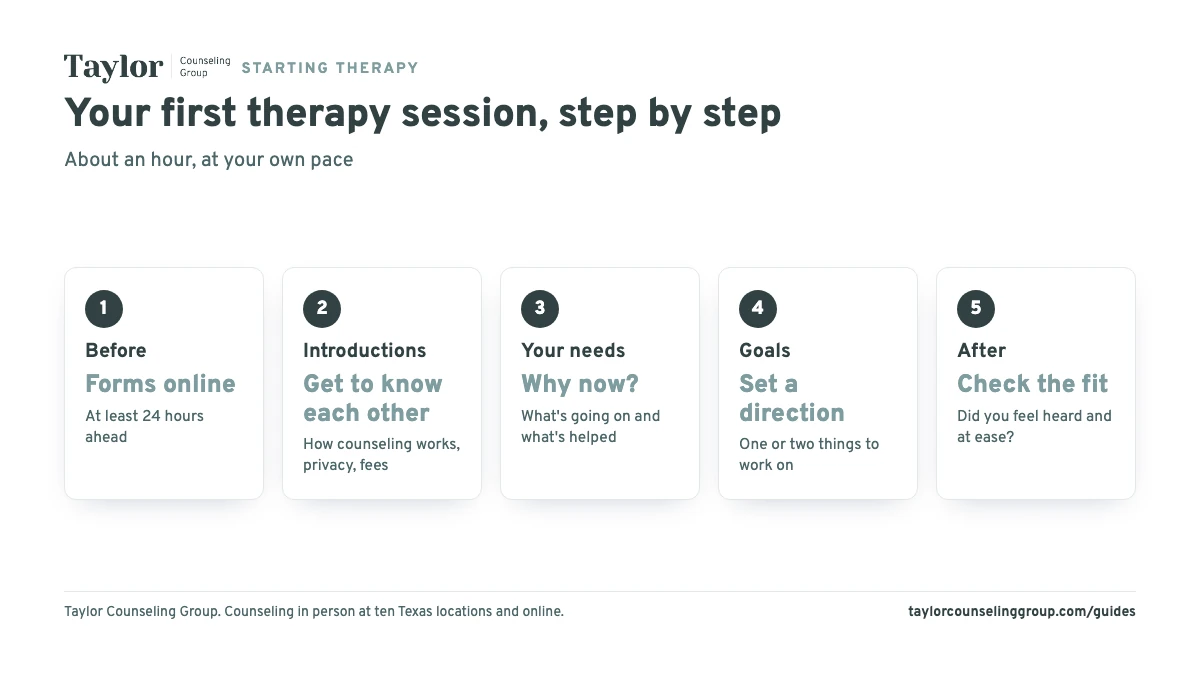
- The hour has two parts: introductions, then talking through what you need.
- You set the pace. You don't have to tell your whole story on day one.
- The biggest thing to notice is whether you feel comfortable with this therapist.
For anyone in Texas with a first counseling appointment coming up (or almost booked) who’d like to know what the hour will feel like before walking in.
What actually happens in a first therapy session, start to finish?
Your first therapy session is mostly a conversation: you and your therapist get to know each other, they explain how counseling works, and they ask what’s brought you in and what you’d like to change. It lasts about an hour, and you don’t need a diagnosis or a perfect explanation to start. You share at your own pace, and by the end you’ll have a feel for whether this therapist is a good fit and what the next few sessions might look like.
When you’re ready for that first hour, our individual counseling therapists will meet you where you are, in one of our offices or online, and help you set goals that are yours. For the days before your appointment, read our blog’s guide on How to Prepare for Your First Therapy Session, and browse our Starting Therapy guides for the next questions people usually ask.
What happens before the first session even starts?
Most of the paperwork happens before you walk in, which means more of your hour goes to actually talking. When you register with us, you’ll get an email with links to our online forms. Please complete them at least 24 hours before your first appointment. We’re a paperless office, and missing or incomplete forms can delay the start of your session.
A few other things are worth sorting out ahead of time:
- Payment. You can enter a credit card or HSA debit card in our online portal before your first appointment and keep it on file.
- Insurance. We’re in-network with most major insurance plans, and our support staff will verify your benefits when you register. If you’re still working out coverage, our guide on How to Find an In-Network Therapist walks through the steps.
- Format. Decide whether you’d like to come into one of our offices or meet online. Both work the same way.
Then give yourself a little breathing room before the appointment. Arriving rushed makes it harder to settle in.
How does the first session begin?
Most first sessions have two parts: introductions, then establishing what you need. The introductions come first, and they’re exactly what they sound like. Your therapist will say hello, tell you a bit about how they work and help you get comfortable. Just like any relationship, therapy works best when there’s personal connection and trust, so this part isn’t small talk for its own sake.
Early on, your therapist will also go over the practical side of counseling: fees and payment, what counseling is for and how they tend to work, how your privacy is protected and where its limits are, and who supervises them if they’re a Counselor Associate or practicum student. You’ll have seen some of this in your forms. Hearing it out loud is your chance to ask anything that wasn’t clear.
If you’re nervous, you can say so right at the start. “I’ve never done this before and I’m a little anxious” is a perfectly good opening line. Your therapist hears it often, and naming it usually takes some of the pressure off.
What questions will my therapist ask me?
The second part of the hour is about understanding why you’re seeking counseling. Be ready for lots of questions. They’re not a test; the answers help your therapist understand your needs and what you’d like to work on together.
You’ll likely hear questions like:
- What made you decide to reach out now?
- How long has this been going on, and how is it affecting your day-to-day life: work, sleep, relationships?
- How have you handled your mental health in the past? What helped, and what didn’t?
- Have you been to therapy before? What did you like or not like about it?
- Who do you lean on for support?
- If counseling goes well, what would be different for you?
You don’t need polished answers. “I’m not sure” and “I just know something feels off” are honest answers, and your therapist can work with them. If you’ve been wondering whether what you’re feeling is “enough” to talk about, our guide on How to Tell If Stress Is Affecting Your Daily Life can help you put words to it beforehand.
Do I have to share everything in the first session?
No. You decide how much to share and when. Typically, the first session is about getting to know you and giving you space to talk. After the first few sessions, most people find it easier to trust their counselor and open up.
If there’s something you’re not ready to talk about, you can say, “I’m not ready to go there yet.” That’s a complete answer. A good therapist will respect it and come back to it only when you’re ready, or not at all.
On the other hand, if there’s something specific you want to get into right away, you can. Some people walk in with one thing they’ve been carrying for months and want to say it out loud on day one. That’s fine too. There’s no wrong way to use your first hour.
Will my therapist give me a diagnosis or a plan right away?
You don’t need a formal diagnosis to begin therapy, and you don’t need to walk out of the first session with a label either. The first hour is about listening and understanding, not deciding what’s “wrong” with you.
What you will start to build is a direction. Your individual counseling is client-driven: you work with your therapist to set specific goals you want to reach, and they work with you on a personalized treatment plan for those goals. In the first session, that might be as simple as agreeing on one or two things you’d like to feel or do differently. The plan takes clearer shape over the next few sessions as your therapist gets to know you.
If you have a goal in mind already (“I want to stop lying awake replaying every conversation”), bring it. If you don’t, that’s something you can figure out together. Our blog’s guide to Goal Setting in Therapy has ideas if you’d like to think about it first.
Get matched with a therapist
Easily schedule your appointment online at one of our locations in Central Texas.
What stays private in a therapy session?
What you say in counseling is confidential, and your therapist will explain the limits of that confidentiality before you get started. If you have a question about who could ever see your information, ask it in the first session. It’s a normal question, and you deserve a clear answer.
Notes a therapist writes about the content of your sessions get extra protection, too. Under the federal HIPAA Privacy Rule, as HHS explains, psychotherapy notes kept separate from the rest of your record receive special protections, and with few exceptions your authorization is needed before they’re shared.
If something about privacy is holding you back from booking, call or email our support staff before your appointment and ask.
What if I cry, freeze or don't know what to say?
All three happen, and none of them means the session is going badly. Therapy rooms have tissues for a reason. Crying when you finally say something out loud is common, and your therapist won’t rush you through it.
If your mind goes blank, try one of these:
- “I don’t know where to start.” Your therapist will help you find a starting point.
- Read from a note on your phone. Jotting down a few things beforehand is a great idea if you tend to freeze.
- Describe a recent moment when you felt the thing you came in for, like last Tuesday’s argument or this morning’s dread.
- Talk about the nerves themselves. It’s a real place to begin.
Silence is okay too. A pause while you collect your thoughts isn’t awkward to a therapist. It’s part of the work.
Is a first online session any different?
The conversation is the same; the setup is a little different. Our online sessions take place on a secure, HIPAA-compliant video platform, phone sessions are also available, and there’s never an additional cost to see your counselor by telehealth.
A few things help a first online session go smoothly:
- Find a private spot. A closed door, a parked car or a walk-in closet all work. You’ll talk more freely if no one can overhear.
- Use headphones if others are home.
- Test your link and device a few minutes early, and keep your phone handy in case the video drops.
Some people find it easier to open up from their own couch; others like the clear boundary of an office. If you’re torn, our blog compares Online Therapy vs. In-Person Counseling, and you can always switch formats later.

What's different about a first couples, family or child session?
The shape is similar, but there are more voices in the room.
- Couples. Sessions are typically held with both partners present. Expect your therapist to hear from each of you about what’s going on and what you each hope will change. Problems won’t be fixed in the first session; it takes time and commitment from both of you. If cost is part of the conversation, our guide on How Much Couples Counseling Costs in Texas breaks it down.
- Families. Family therapy can include the whole family or a few willing members, so a first session might not have everyone there, and that’s okay.
- Children. If you’re bringing a child, complete the Consent for Treatment of a Minor form in your registration email. Play therapy is typically for kids 5 to 12, and you can schedule a consultation for your child before scheduling an appointment. Our guide on Whether Play Therapy Is Right for Your Child explains what those sessions look like.
For kids, a simple preview helps: “You’re going to meet someone whose job is to help kids with big feelings. You can talk or play, and you can’t get it wrong.”
How will I know if my therapist is a good fit?
The most important thing you’ll learn in your first session is whether you feel your counselor is a good fit. That matters. A 2018 meta-analysis of 295 studies covering more than 30,000 adults in therapy, published between 1978 and 2017, found a consistent link between the strength of the client-therapist relationship and how therapy turned out, in person and online.
After your first session, ask yourself:
- Did I feel listened to, not judged?
- Did they explain things in a way that made sense to me?
- Could I imagine telling them something harder next time?
Give it a little time. One session is just one session, and it often takes a few before you really know. But if it still doesn’t feel right after your initial sessions, tell us. Our team will help you move to another provider in our group who better fits your needs. You won’t hurt anyone’s feelings, and you won’t have to start your search from scratch.
What happens after the first session?
Before you leave, you’ll usually talk about when to meet next. How often and how long you meet depends on your needs, the goals you set and the progress you make, and you and your therapist decide that together. Treatment can range from just a couple of sessions to years, so nobody expects you to know the number on day one.
Afterward, give yourself a few minutes before jumping back into your day. Take a short walk, sit with a coffee or jot down what stood out. Notice how you feel: lighter, tired, stirred up. All of those are normal after a first session.
For tips on the days leading up to your appointment, our blog has a full guide on How to Prepare for Your First Therapy Session.
Find a location near you
We provide affordable, reliable, and accessible care across Central Texas. Find a location near you.
What Texas rules mean for your first session
A couple of Texas-specific details shape the start of counseling here. Under 22 Texas Administrative Code §681.35, licensed professional counselors must give you key information before services begin, including fees and payment arrangements, counseling purposes, goals and techniques, the limits on confidentiality, and the name and qualifications of any supervisor. That’s why the first part of your session covers the practical side, and why it’s worth reading your intake forms instead of clicking through them.
For a child named in a custody agreement or court order, the same rule requires the counselor to get and review a current copy before counseling starts. In practice, that means bringing custody documents or a copy of the current court order that shows your authority to consent to your child’s treatment.
You can also look up any Texas counselor’s license, including its status and any public disciplinary history, through the Texas Behavioral Health Executive Council’s license search. All of our providers are professionally trained and properly licensed.
A made-up example: one person's first hour
Here’s an illustration, invented to show how a first session can unfold. Say Dana, in her thirties, has been feeling stressed and down since a move and a new job, and books her first-ever counseling appointment.
- The day before: She fills out her forms and adds her card to the portal. She writes three things on her phone: can’t sleep, snapping at her partner, feels lonely.
- The first few minutes: Her therapist introduces themselves, explains how sessions work, talks through privacy and fees, and asks if she has questions. Dana says she’s nervous. Saying it out loud helps her relax.
- The middle: Her therapist asks what made her reach out now, how long she’s felt this way, and what’s helped before. Dana reads from her note, then ends up talking mostly about how much she misses her old friends. She skips a question about her family, saying she’s not ready, and her therapist moves on.
- The end: They agree on a starting goal, sleeping better and feeling less alone, and pick a time for next week.
Dana leaves tired but lighter. Nothing is solved in one hour, and nobody expected it to be, but she knows she liked this therapist. That’s a strong start.
Frequently asked questions
How long is a first therapy session?
Most in-person and online therapy sessions last about an hour, and the first one is usually the same length.
What should I bring to my first appointment?
Your completed online forms do most of the work, so finish them at least 24 hours ahead. It helps to bring a short note of what you want to talk about, your insurance card if you’re using insurance, and for a child, any custody documents or court order showing your authority to consent.
What if I've had a bad experience with therapy before?
Say so in your first session, along with what didn’t work. That’s useful information, and it helps your new therapist shape sessions around what you need this time.
Will I feel better after the first session?
Some people walk out feeling lighter; others feel tired or stirred up. Both are normal. Change takes time, and one session is a starting point, not a finish line.
Who can I call with questions before my appointment?
Our support staff is available 8am–8pm Monday to Friday and 9am–3pm on Saturdays at (214) 530-0021, or you can email support@taylorcounselinggroup.com.
Key takeaways
- Complete your intake forms online at least 24 hours before your first appointment.
- A first session has two parts: getting to know each other, then talking through what you need.
- You don’t need a diagnosis, and you don’t have to share everything at once.
- Online sessions work the same way and never cost extra.
- The most useful thing to notice is whether you feel comfortable with your therapist; if not, we’ll help you switch.
Getting the help you need shouldn't be complicated
So we make scheduling an appointment easy with our online booking tool.
More in this section
Sources
- 22 Tex. Admin. Code § 681.35 – Informed Consent — Legal Information Institute
- Does HIPAA provide extra protections for mental health information compared with other health information? — HHS
- The alliance in adult psychotherapy: A meta-analytic synthesis — Psychotherapy (PubMed)
- Online Search/Verify a License — Texas Behavioral Health Executive Council

Dr. Christopher Taylor
Christopher S. Taylor, Ph.D., is the founder of Taylor Counseling Group, an existential psychotherapist and the author of You Are Here. A Board-Approved LPC Supervisor, he was appointed by Governor Greg Abbott to the Texas State Board of Examiners of Professional Counselors, where he was later elected Vice Chair.
This guide is general information from Taylor Counseling Group. It is not medical advice, a diagnosis or a substitute for care from a licensed mental health professional, and reading it does not create a counseling relationship. If you are in danger or need help right away, call 911 or go to the nearest emergency room.