
How do I find an in-network therapist?


- How can I find a therapist who takes my insurance?
- What does "in-network" mean for therapy?
- What should I ask my insurance before I start looking?
- How do I search my insurer's provider directory?
- Can I trust what the provider directory says?
- What should I ask the therapist's office?
- Why might a practice take my plan but not every therapist?
- How do I find an in-network therapist with you?
- What will I pay for an in-network session?
- What if the therapist I want is out of network?
- What if I can't find an in-network therapist with openings?
- What if I don't have insurance or my deductible is high?
- Your mental health coverage rights in Texas
- A made-up example: finding an in-network therapist in a week
- Frequently asked questions
- Key takeaways
- More in this section
- Sources
The short version
- Ask your plan what your outpatient mental health benefits are before you search.
- Use your insurer's provider directory, then double-check with the practice.
- Confirm the specific therapist is in network with your plan, not just the office.
- Get your benefits verified; verification doesn't guarantee payment, but it prevents surprises.
For people in Texas who want to use their health insurance for counseling and would like to get the network question right before the first session.
How can I find a therapist who takes my insurance?
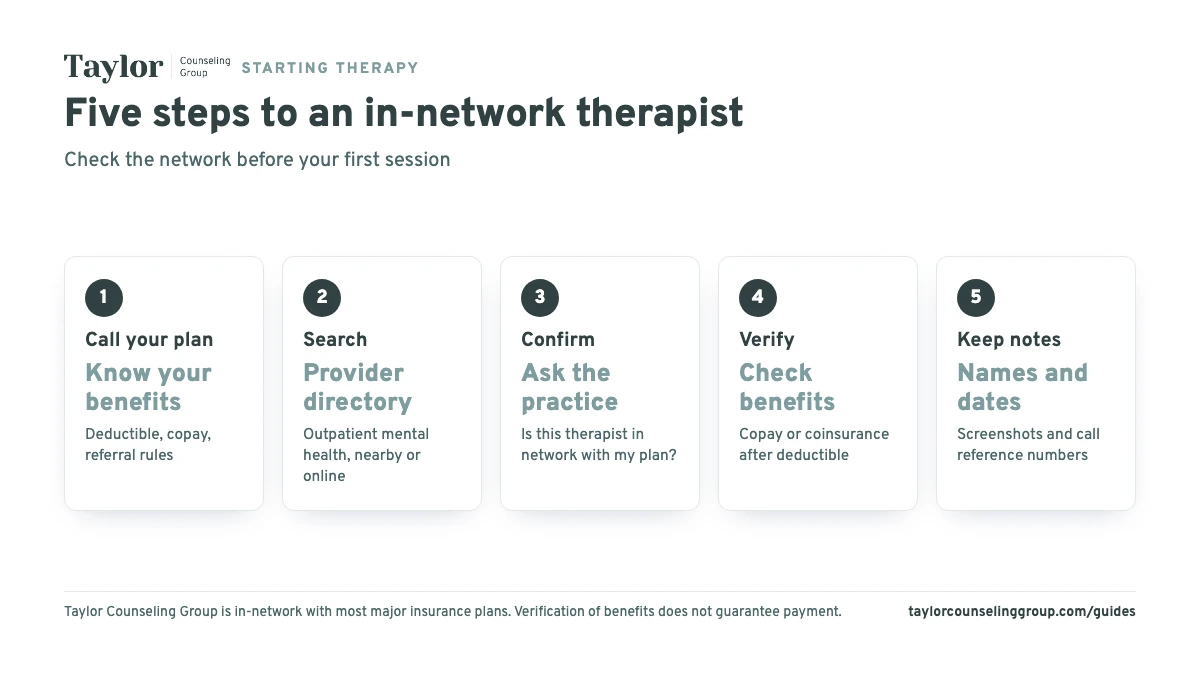
Start with your plan: call the member services number on your insurance card or search your insurer’s online provider directory for outpatient mental health providers near you or offering telehealth. Then confirm with the practice that the specific therapist you’d see, not just the practice, is in network with your exact plan. Finally, have the practice verify your benefits so you know whether you’ll owe a copay or coinsurance and how much of your deductible is left.
Once your insurance is sorted, the next step is finding the right person. Our individual counseling therapists work in person at our Texas locations and online, and our support staff will verify your benefits when you register. Our blog’s guide on Navigating Insurance and Counseling covers the basics of using insurance for therapy, and our Starting Therapy guides answer the next questions people usually ask.
What does "in-network" mean for therapy?
Your health plan’s network is the group of providers it has contracted with to provide care. A therapist who’s “in network” has a contract with your plan; one who’s “out of network” doesn’t. HealthCare.gov’s glossary has plain definitions of these terms if you’d like them handy.
Why it matters: with an in-network therapist, your out-of-pocket cost is typically a copay or coinsurance once your deductible is met. With an out-of-network therapist, your plan may pay less or nothing, and out-of-network coinsurance usually costs you more than in-network coinsurance.
Some plans have a “tiered” network, where you pay more to see certain providers even though they’re all contracted. If your plan materials mention tiers, preferred providers or participating providers, ask which tier a therapist falls in before you book.
What should I ask my insurance before I start looking?
A short call to the member services number on your card saves a lot of guesswork later. Ask about your mental health benefits specifically, since they can work differently from your medical benefits:
- Do I have outpatient mental health or behavioral health benefits?
- How much of my deductible have I met this year?
- After the deductible, will I pay a copay or coinsurance for a counseling session?
- Do I need a referral or prior approval before I start?
- Are telehealth sessions covered the same way as in-office visits?
- Does my plan have a tiered network for mental health?
- Do I have any out-of-network benefits?
Write down the date, the name of the person you spoke with and a reference number for the call. Our blog’s guide on Navigating Insurance and Counseling explains copays, coinsurance and deductibles in more detail.
How do I search my insurer's provider directory?
Most insurers have a searchable provider directory on their website or app. Log in to your member account if you can, since that version is usually tied to your exact plan. Then narrow the search:
- Type of care: choose outpatient mental health or behavioral health, not psychiatry, unless that’s what you want.
- Type of provider: counselors (LPC), marriage and family therapists (LMFT), clinical social workers (LCSW) and psychologists all provide therapy.
- Location or telehealth: search by ZIP code, or filter for providers who offer online sessions in Texas.
- What you need: some directories let you filter by specialty, age group, couples or family work, or language.
Make a short list of three to five practices. Directories aren’t always current, so treat each listing as a lead to check, not a final answer.
Can I trust what the provider directory says?
Mostly, but always confirm. Under the federal No Surprises Act, health plans must verify and update their directory information at least once every 90 days, and they must respond within one business day when you ask about a provider’s network status. Providers also have to tell plans when they join or leave a network.
There’s a safety net, too. If a plan’s directory had the wrong information and you got out-of-network care because of it, the plan can’t charge you more than your in-network cost sharing, and you may be entitled to a refund of what you paid above that amount. That’s one more reason to keep a screenshot of the listing and notes from any calls.
Still, the easiest way to avoid a mix-up is to ask the practice directly before your first session.
What should I ask the therapist's office?
When you call or email a practice from your list, be specific. “Do you take my insurance?” can get a quick “yes” that doesn’t tell the whole story. Ask instead:
- Is the specific therapist I’d be seeing in network with my plan, by its exact name?
- Will you verify my benefits before my first session?
- What will I likely owe at each visit, a copay or coinsurance?
- Are online sessions billed the same way?
- What happens if my plan doesn’t pay a claim?
Have your insurance card in front of you, since the plan name and member ID matter more than the company name. Our guide on What to Expect in Your First Therapy Session covers the rest of what to sort out before day one.
Get matched with a therapist
Easily schedule your appointment online at one of our locations in Central Texas.
Why might a practice take my plan but not every therapist?
Being in network is a contract between your plan and each provider, so it can vary therapist by therapist inside the same practice. Two common reasons:
- Credentialing. Some providers may still be in the process of credentialing with an insurance company and may not be able to accept your plan yet.
- License level. In Texas, Licensed Professional Counselor Associates can’t accept insurance for payment, though they can work for reduced rates.
That’s why the most useful question is always about the specific therapist. When you’re matched, confirm that your therapist can take your plan.
How do I find an in-network therapist with you?
We’re in-network with most major insurance plans, and we’re happy to check your benefits for you. Just email your insurance information to support@taylorcounselinggroup.com. You can see how payment works on our Insurance & Payment page.
The quickest route is our Get Matched form. It asks what kind of counseling you’re looking for, whether you’d like to meet in one of our offices or online, and who your insurance provider is (you can add your insurance ID or skip it if it isn’t handy). Private Pay and our Affordable Care Program are options on the form too. Our support staff will verify your insurance benefits when you register.
For veterans, service members and military families, Tricare and TriWest are among the insurance options we list. Our veteran counseling page has more.
Verification of benefits doesn’t guarantee payment, and you’re responsible for the full cost of sessions. Checking early means fewer surprises.
What will I pay for an in-network session?
When we accept your insurance, your out-of-pocket cost is typically a copay or coinsurance, provided your deductible has been met. Our insurance contracts don’t allow us to post our contracted rates, so the exact number depends on your plan and where you are in your deductible.
Timing matters. Early in your plan year, before your deductible is met, you may pay more per session than you will later in the year. If you’re comparing options, ask your plan how much of your deductible is left.
Online sessions never cost extra with us, and we accept all major credit cards, along with FSA and HSA cards and HRA accounts. Looking for counseling as a couple? Our guide on How Much Couples Counseling Costs in Texas covers insurance questions that come up for couples.

What if the therapist I want is out of network?
Sometimes the therapist who feels like the right fit isn’t in network with your plan. You still have options. If the counselor you’re working with isn’t in network with your insurance, we’ll work with you to file as an Out of Network Provider (OON). All plans are billed at our Usual and Customary Rate (UCR).
How much comes back to you depends on your plan’s out-of-network benefits. Ask your plan whether you have them, whether there’s a separate out-of-network deductible, and how to submit a claim.
If out-of-network costs don’t work for you, you can ask to be matched with an in-network therapist instead, pay our private rate of $130 per session, or see whether you qualify for our Affordable Care Program.
What if I can't find an in-network therapist with openings?
It’s frustrating to call down a list and hear “not accepting new clients.” A few things can widen your options:
- Search for online therapy. Telehealth lets you see a therapist anywhere in the state, not just near home. Our online sessions take place on a secure, HIPAA-compliant video platform, and phone sessions are also available.
- Ask your plan for help. Tell member services you’re having trouble finding an available in-network mental health provider and ask them to help you find one.
- Be flexible on time. Daytime or less popular slots often open sooner.
- Ask to be matched. A practice with many therapists can often find someone in network with your plan who has room.
If you’re searching on behalf of a child, the same steps apply. Our guide on Whether Play Therapy Is Right for Your Child explains what kids’ sessions involve.
What if I don't have insurance or my deductible is high?
Insurance isn’t the only way in. Our standard private rate is $130 per session.
Our Affordable Care Program has income-based rates: sessions with a Counselor Associate start as low as $50 per hour session, and sessions with a practicum student start as low as $30. You’ll meet with a Licensed Professional Counselor Associate or practicum student under a Board Approved Professional Supervisor. The program doesn’t use insurance, and you don’t need to be in-network. To see if you qualify, ask for the Affordable Care Assistance Request form when you register; eligibility is based on your income and household occupancy.
If you have a high deductible you’re unlikely to meet this year, it’s worth comparing what you’d pay through insurance with the Affordable Care rate.
Find a location near you
We provide affordable, reliable, and accessible care across Central Texas. Find a location near you.
Your mental health coverage rights in Texas
As the Texas Department of Insurance explains, if your health plan covers mental health issues, the law requires it to give the same level of benefits, such as the number of office visits, as it does for a physical illness or injury. This is called mental health parity, and it also means health plans must have enough in-network providers for routine and emergency care of behavioral health issues.
If a mental health claim is denied, ask why. Your plan has a process to review and appeal denied claims. If the appeal doesn’t solve the problem, you can ask for an external review: an independent third party reviews your case, the plan must honor the decision, and the review is free to you. The state’s insurance Help Line at 800-252-3439 can answer insurance questions and explain your appeal options.
A made-up example: finding an in-network therapist in a week
Here’s an illustration, invented to show how the steps fit together. Say Marcus in Fort Worth has been feeling anxious and overwhelmed and wants to use his employer’s health plan for counseling.
- Monday: He calls the number on his card. He learns he has outpatient mental health benefits, he’s met part of his deductible, telehealth is covered the same as office visits, and he doesn’t need a referral. He writes down the rep’s name and the call reference number.
- Tuesday: He searches his insurer’s directory for counselors near his ZIP code and online, and screenshots four listings.
- Wednesday: He emails two practices with his plan name and member ID, asking whether the specific therapist he’d see is in network. One replies that its listed therapist isn’t taking his plan yet. The other offers to match him with an in-network therapist.
- Thursday: The second practice verifies his benefits and tells him to expect a copay or coinsurance after his deductible.
- The next week: He fills out his intake forms and has his first session online.
Marcus’s plan, timeline and costs are made up. Yours will depend on your plan and on who has openings, but the order of steps works the same way.
Frequently asked questions
Does in-network mean therapy is free?
Usually not. With an in-network therapist, you typically pay a copay or coinsurance once your deductible is met, and the amount depends on your plan.
Can I see a Counselor Associate using my insurance?
No. In Texas, Licensed Professional Counselor Associates can’t accept insurance for payment, but they can work for reduced rates through our income-based Affordable Care Program.
Do I need a referral to see a therapist?
It depends on your plan. Some plans ask for a referral or prior approval and others don’t, so ask member services before your first session.
What if my insurance changes after I've started counseling?
Tell our support staff as soon as you know, and send your new insurance details so they can verify your benefits again before your next session.
Is online therapy covered the same as in-person therapy?
Ask your plan, since telehealth coverage can vary. On our side, there’s never an additional cost to see your counselor online instead of in the office.
Who can help me with insurance questions?
Our support staff is available 8am–8pm Monday to Friday and 9am–3pm on Saturdays at (214) 530-0021, or email support@taylorcounselinggroup.com.
Key takeaways
- Call your plan first and ask about outpatient mental health benefits, your deductible and any referral rules.
- Use your insurer’s provider directory as a starting list, then confirm with the practice.
- Ask whether the specific therapist is in network with your exact plan; it can differ within one practice.
- We’re in-network with most major insurance plans and will verify your benefits; verification doesn’t guarantee payment.
- If insurance doesn’t work out, our private rate is $130 per session, and income-based Affordable Care rates start lower.
Getting the help you need shouldn't be complicated
So we make scheduling an appointment easy with our online booking tool.
More in this section
Sources
- Network – Glossary — HealthCare.gov
- Preferred provider – Glossary — HealthCare.gov
- Out-of-network coinsurance – Glossary — HealthCare.gov
- No Surprises Act Overview of Key Consumer Protections — CMS.gov
- How to get help with a mental health issue — Texas Department of Insurance

Dr. Christopher Taylor
Christopher S. Taylor, Ph.D., is the founder of Taylor Counseling Group, an existential psychotherapist and the author of You Are Here. A Board-Approved LPC Supervisor, he was appointed by Governor Greg Abbott to the Texas State Board of Examiners of Professional Counselors, where he was later elected Vice Chair.
This guide is general information from Taylor Counseling Group. It is not medical advice, a diagnosis or a substitute for care from a licensed mental health professional, and reading it does not create a counseling relationship. If you are in danger or need help right away, call 911 or go to the nearest emergency room.